When a football fan from the 21st century thinks about the city of Warsaw, the famous Legia comes to mind, with their very well known ultras, their many domestic trophies won and their constant presence in european competitions. Not many would associate the polish capital to one of the other football clubs: Gwardia, polish cup winners in 1954, dissolved in 2018, Hutnik have never been in the Ekstraklasa and are unknown to most, and then there's Polonia. The black shirts, as the club's players are nicknamed, were once the most important club in Warsaw and their history of resistance and oppression deserves to be told.
Let's take a step back to the beginning: back in 1911 Poland didn't exist as a country, the land was split between the big empires of that time, and the city of Warsaw was part of the Russian partition. This makes the choice of the name Polonia much more meaningful in the context of the russification of Poland imposed by the empire. The patriotic symbolism of Polonia Warsaw doesn't end there: the black shirts were chosen representing the mourning for the division of the polish motherland, and the white shorts and red socks clearly show the colours of the polish flag.
 |
| Polonia fans show a tifo of the club's three colours. From legionisci.com |
The inter-war period was a positive spell for the warsawian club, with success on the field and a growing fanbase outside of it. After the invasion of Poland of 1939, the city of Warsaw ended up in the nazi-occupied area, and the Germans banned Poles from practicing sports, but this never stopped Polonia Warsaw from participating in underground championships and winning the illegal league of Warsaw in 1942 and 1943.
The Warsaw uprising saw at least 150'000 civilians lose their lives as the Polish underground resistance tried to free the city from German occupation, and the club's stadium in Koniwiktorksa street was the scene of bloody battles that saw 12 insurgent perish between the 21st and 22nd of August in 1944. Between them were Polonia players Aleksander Justynowicz, Ludwik Skrzypek and Tadeusz Gebethner, who later died in a hospital in a prison camp. Others, like Gromelski, Twardo, Dzierzbicka and Zygmunt Matusik were murdered in the atrocities that happened in the Auschwitz, and more were deported to other concentration camps. The club, like the city of Warsaw and the entirety of Poland, suffered a lot during the nazi occupation. Murals showing the Polish resistance were painted outside the walls of Polonia's stadium to remember those who fought against the German occupation in the Warsaw uprising.
 |
| From stadiony.net |
Right after the war ended, with Warsaw and their own stadium in ruins, Polonia managed to claim their first polish title in 1946. This triumph was symbolic for a city that suffered an infinite amount of pain and destruction during the war, and saw the club strengthen their role as the capital's main and most beloved club. Only in 1951 could the black shirts return to their own ground in Koniwiktorksa street. However, the new occupation under Stalin's Soviet Union saw each polish club affiliated to a national sponsor: sports club were forced to be associated to a specific industry, and Polonia lost its name, becoming Kolejarz Warsaw, its colours, playing in burgundy shirts instead of their traditional black shirts, and their strength in the polish league, as the Polish State Railways couldn't keep up with the power and budget of the Army or the mining and metallurgy sections which sponsored other clubs.
This systematic disadvantage saw the club get relegated to the second tier in 1952, but still heroically win the Polish cup in december of the same year in a final against city rivals Legia, who were instead sponsored by the Army. What followed were decades in the lower leagues, with the only satisfaction coming in 1956 when the club returned to the original Polonia Warsaw denomination. When the black shirts managed to get back into the top tier in 1992, exactly 40 years after the relegation, Polonia's popularity had massively decreased in favour of Legia's, which in the meantime had won 4 league titles and 9 Polish cups, meaning they also played in european competitions against the biggest clubs in the continent.
In this new era in the top flight, the year with the fondest memories for Polonia fans is without a doubt 2000. Despite not being amongst the title candidates at the beginning of the 1999-2000 Polish championship, a title push saw the season culminating with a 0-3 win away at Legia to clinch Polonia's second ever league title, not long after they also won the league cup with another 1-2 away win always in their biggest rivals' home.
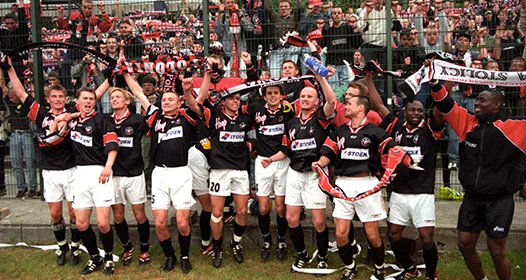 |
| From kspolonia.pl |
The following decade saw the club stable as a mid-table club in Ekstraklasa, apart from a couple years in the second tier, until the club filed for bankruptcy in 2013. The following year saw them restarting their climb from the fourth tier of Polish football, a climb that as of now has got them back up to the second tier and hopeful of a playoff spot to get them back where they belong.
Because Polonia Warsaw may suffer for years, even decades, but just like the Polish people they so proudly represent they will eventually get back up.
Comments
Post a Comment