The city of Paris is home to more than 2.2 million people, and if we consider the whole Île-de-France area then the population rises to over 12.2 million. How is it possible that in a region that has more inhabitants than Belgium, Sweden and Portugal there's only one prominent football club? Paris Saint Germain may not have a rival to fight against for bragging rights over the French capital, at least for now, but football in the city does not stop at Ligue 1's dominant side.
 |
| From thepeninsulaqatar.com |
Paris Saint-Germain and Paris FC
First of all, we have to know how PSG even started, because unlike most of Europe's biggest clubs the French champions do not have a long history to look back at. In the summer 1969 a group of local businessmen wanted to create a club that could compete in the top tier and bring back a title that had not been won by a Paris club since Racing Club's 1936 triumph, so Paris FC was formed on August 1st, 1969. This new club attempted to merge with CS Sedan, a club that had been in the top division for more than a decade, but the merger was refused, so the Parisians had to look for a merger in the second division. Stade Saint-Germain was a club founded located in the western suburbs of the capital, 20 km from the city center, they played in the second division and when the merger offer came they accepted it. This fusion gave birth to the Paris Saint-Germain that we know today.
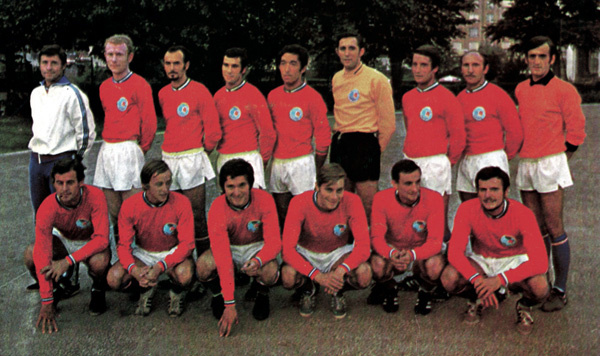 |
| PSG's 1970-71 side. From histoiredupsg.fr |
This marriage however only lasted two years: the mayor of Paris refused to support a club that wasn't located inside the city, so Paris FC split from Paris Saint-Germain: the former retained first division status and all the players, and the latter were relegated to the third division. Ironically enough, PSG moved back up into the top flight in the same season Paris FC were relegated to the second tier in 1974: the mayor's chosen club only played one more season in the top flight in 1979 and have never set foot in Ligue 1 again to this day.
Paris Saint-Germain have been stable in Division 1/Ligue 1 ever since, winning their first few trophies in the 80's and racking up 12 league titles and 15 Coupe de France titles in total, numbers that keep rising year after year.
Paris FC fell into the fifth division in the 1980's and has been slowly climbing back up since then. The club was stable in the third tier in the 90's before going down and up again in the 2000's. In 2015 the club finally gained promotion to Ligue 2 alongside city rivals Red Star FC, although the jump was tricky and they were relegated again before earning their final promotion in 2017. Nowadays PFC is pushing for a historic promotion to Ligue 1, hoping to challenge PSG's dominance over the city and in domestic competitions.
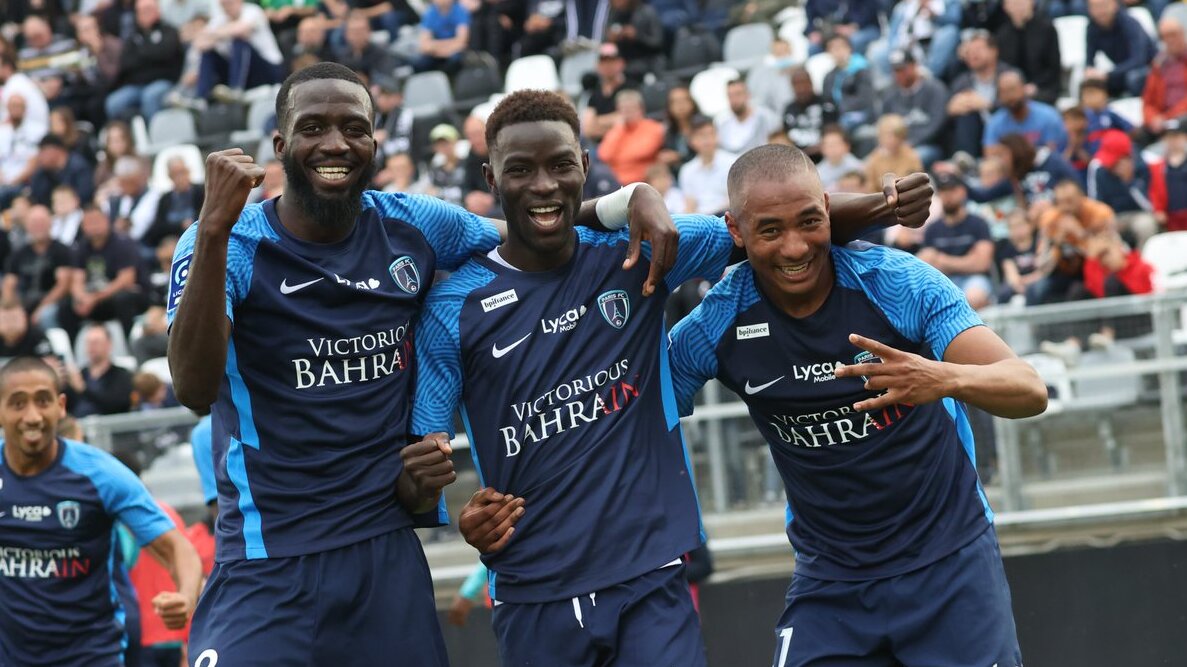 |
| Paris FC. From socialmediasoccer.com |
The other clubs from Paris
What about the other clubs from Paris? We've mention Red Star FC, but as you can imagine an area of 12 million people cannot possibly have just three clubs. With the French population being so centered around the capital, it's hard to imagine how any other city could support two professional clubs. Marseille would be the only city big enough, but OM is so big in the Provence region that a second club is almost unthinkable. This situation created a culture in which every city has its own main football club, and the derbies are regional instead of within the cities.
Paris, however, is definitely big enough, although at this time only one club from the capital competes in Ligue 1. We've seen Paris Saint-Germain and Paris FC, let's take a look at the other Parisian clubs.
Red Star FC is the fourth oldest football club in France, after Le Havre AC, Girondins de Bordeaux and fellow parisians Standard AC. It was founded in 1897 by Jules Rimet, the legendary FIFA president who served from 1921 to 1954. Older folks will remember that the original World Cup Trophy was named after him! Red Star currently compete in Ligue 2. They have never won Ligue 1, but they conquered the Coupe de France on five occasions, most recently in 1942.
Les verts et blancs, as they are nicknamed, are known for their loyal supporters, who are openly antifascist and often left-wing, representing the working-class of the banlieue in the northern suburbs of Paris, around Saint-Ouen. The support is always intense regardless of the division, with the 5,600 seats of the Stade Bauer often sold out. The club has fierce rivalries with US Créteil and Paris FC.
 |
| From leparisien.fr |
Racing Club de France
is based in the Parisian suburb of Colombes, about 10 kilometres from
the city centre. It was formed in 1882 as a sports club, and the
football section was started in 1896, making it one of the oldest
football clubs in the country. They were one of the founding members of
Ligue 1, of which they have won a title in 1936, and conquered five
Coupe de France titles as well. They play their home games at Stade
Yves-du-Manoir and currently compete in Championnat National 3, the
fifth tier.
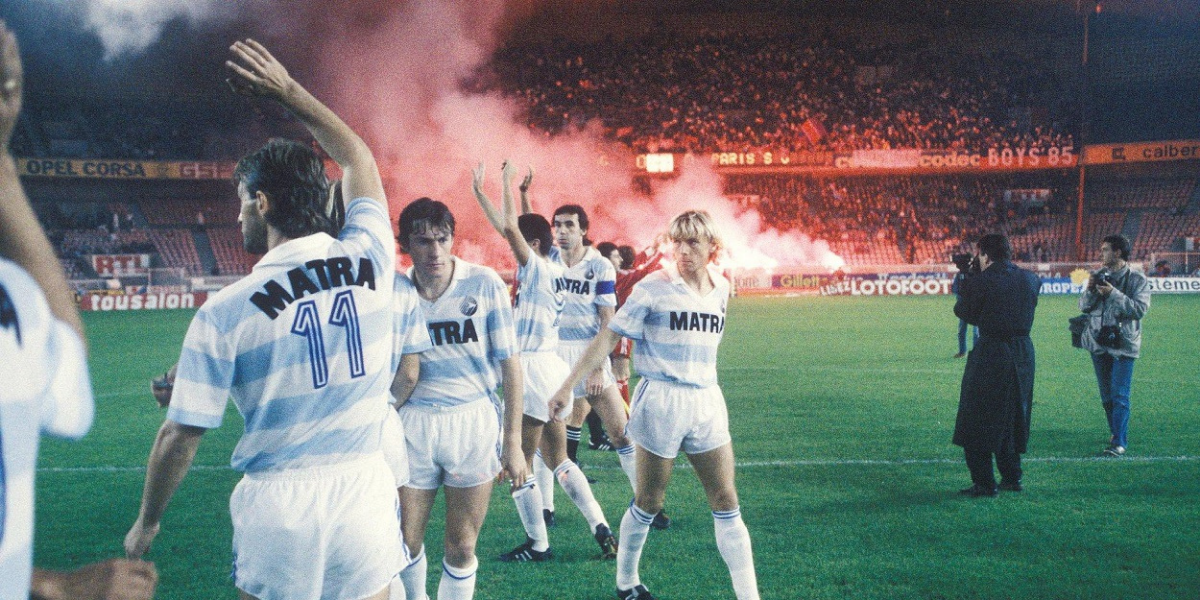 |
| From racingfoot.fr |
FC Versailles play in the Championnat
National, and represent the famous commune of Versailles, home of the
Chateau and the gardens, which are UNESCO World Heritage Sites. Their
home stadium is the Stade de Montbauron, but have to play their
third-tier home matches at the Stade Jean-Bouin, just across the street
from the Parc des Princes. Although the club became famous for its
beautiful kits, the team earned front pages for their football successes
as well, reaching the semi-finals of the Coupe de France in 2022.
US Créteil-Lusitanos are based in Créteil, in
the southeastern suburbs of Paris. They currently compete in Championnat
National 2 (the fourth tier) but have a past in Ligue 2 in the 2000's
and once got to a Coupe de France quarter final in 1986. The club has
loyal ultras, but the attendance varies greatly depending on the
division: the turnout could be around 3,000 spectators for Ligue 2
matches, but drop off to 500 if Créteil relegate to the regional
leagues.
Standard Athletic Club was founded by young british men who were working on the building of the Eiffel Tower. As we said, they are one of the oldest clubs in France: in fact they have won the first ever French football championship in 1894, and five titles in total! They nowadays play in local leagues in Paris.
Union Sportive Suisse de Paris was founded in 1894 as United Sports Club and finished second in the 1904 championship. They merged with FC Switzerland in 1906, hence the name, and they regularly recruit players who are Swiss-born or have Swiss heritage. They currently compete in Championnat Régional 1, the sixth tier of French football.
CA Paris-Charenton is a merger of CA Paris, founded in 1892, and SO Charentonnais. CA Paris won the Coupe the France in 1920 and was runner-up in 1928, and also played two seasons of Ligue 1 in the 30's. They kept professional status until 1963, and merged with SO Charentonnais a year later. They now play at a regional level.
Stade Français Football play in the suburb town of Vaucresson. Although the rugby team is more successful than the football one, the club has opened its football section in 1900. It participated in two editions of the Cup of Fair Cities in 1965 and 1966, defeating Real Betis and managing draws against Juventus and Porto, but the golden era of the club has been gone for a while and the team abandoned professionalism to compete in the lower local divisions.
Paris 13 Atletico represents the 13th arrondissement of Paris and competes in the third tier, the Championnat National, which was reached for the first time with the 2022 promotion.
Other local clubs that compete in regional leagues are AC Boulogne-Billancourt, FCM Aubervilliers, who were Warren Zaire-Emery's first club, UJA Maccabi Paris Métropole, which was founded as a social-sport club for the Jewish community, Entente SSG, FC Fleury 91, ASF Le Perreux and Ménilmontant FC. From 2003 to 2015 there was even a team called Paris Foot Gay which was made up mostly of openly homosexual footballers: their goal was to tackle homophobia in football.
Paris Saint-Germain are 100% still the dominant force in Paris and in French football as a whole, but with Paris FC's quest to join Ligue 1 and with the many lower league clubs that populate the French capital, let's just say that if you happen to visit the city and want to attend a match or two you will not leave empty handed. Here's a map, just in case.

Comments
Post a Comment