Between 1949 and 1990 Germany suffered the political consequences of World War II. Its land was divided in occupied zones: some parts were annexed by Poland, while modern-day German territories were divided between the two post war blocs. The Western and Southern parts of the country were given to the Allies, while the Eastern part ended up under Soviet control. Even Berlin was split in half by its famous wall.
Nowadays the country is reunited, but the effects of the divide are still extremely visible in terms of economy, politics, demographics, religion and the most important of all: football.
Football in Eastern Germany
A new top-flight football league was established in East Germany in 1949, as separate sports competitions were created following the division of the country. The DDR-Oberliga, as it was called from 1958 onwards, was contested for most of its history by 14 teams.
12 different clubs won the league over this period, but the most successful were BFC Dynamo Berlin, who won 10 straight titles, followed by Dynamo Dresden and 1. FC Frankfurt (then called Vorwärts) who won 8 and 6 titles respectively.
Being their own country allowed East Germany to have representation in the continental competitions, and so some clubs took the opportunity to clash with European giants in the European Cup and UEFA Cup knockouts. Many clubs have had the chance, but Magdeburg are the only club to have won a trophy.
 |
| Magdeburg players celebrate their historic 1974 Cup Winners Cup triumph |
The East German National team didn't have much success in international football, although they managed to qualify to the 1974 World Cup held in... West Germany. The group stage draw put them up against Australia, who they beat 2-0, Chile, who they drew, and their brothers from the other side of the Iron Curtain.
East Germany beat West Germany 1-0 thanks to a historic goal from Sparwasser, qualifying for the second round, which saw them eliminated in a group with the Netherlands, Brazil and Argentina. This would be their only World Cup appearance, and West Germany went on to win the final in Munich against the Netherlands.
East Germany never qualified for the Euros (at the time only few teams participated in the proper tournament), but won four medals at the Olympic Games including a gold medal in the 1976 Olympics in Canada.

Germany had two National teams for over 40 years
After the German reunification of 1990, one last Oberliga season was played under the name of NOFV-Oberliga (which means Northeast Football Federation Premier League).
The clubs competing in this last season had much more to play for than just the title: their future relied on their success in the league, as East German clubs were about to be redistributed in the German football pyramid based on the 1990-91 Oberliga standings.
The top two spots granted qualification for the 1991-92 Bundesliga: Hansa Rostock won their first title and qualified for the top tier alongside Dynamo Dresden.
The next four spots sent Rot-Weiss Erfurt, Hallescher, Chemnitzer and Carl Zeiss Jena to the 2. Bundesliga, and two more 2. Bundesliga spots were won by Lokomotive Leipzig and Stahl Brandenburg via playoffs.
The rest of the league, so record champions Dynamo Berlin, EFC Stahl, 1. FC Frankfurt, Magdeburg, Energie Cottbus and Sachsen Leipzig were sent to the NOFV-Oberliga, the new third tier.

So, the entire league was split up, and the clubs had wildly different fortunes based on their league standings in that one single season. But after more than three decades, where are they now?
[Disclaimer to avoid confusion to the reader: the German football structure changed since 1991. What started as Bundesliga - 2. Liga - Oberliga saw over the years the addition of the Regionalliga and then the 3. Liga, both just below the 2. Liga. Today's structure is thus Bundesliga - 2. Liga - 3. Liga - Regionalliga - Oberliga]
Where are they nowadays?
Let's start with recordmen BFC Dynamo, who won 10 consecutive Oberliga titles between 1979 and 1988. The claret and whites also won three cup titles and showed strong European campaigns, particularly so during the start of their period of dominance.
In the 1972 Cup Winners' Cup they made it all the way to the semifinals, where Dynamo Moscow beat them on penalties after two hard fought 1-1 draws. They've then reached the quarter finals of the European Cup twice, in 1982 and 1984, suffering defeats at the hands of Aston Villa and A.S. Roma.
The reunification hurt Dynamo: the best talents all left for Western teams, meaning the club's dominance was now gone. Their last European tour saw them eliminated in the second round of the 1990 Cup Winners' Cup by A.S. Monaco on away goals, and as said a poor 1990-91 league campaign only qualified them for the third tier in the reunified German league.
Dynamo, having lost all its players and its top tier status in a couple of years, fell on hard times: it spent the entirety of the 90's in the third division, and then relegated to the fourth in 2000 while in the middle of an economic crisis and then even further in the fifth division 2002.
This once great club had to restart from the Verbandsliga Bayern, and so far it has climbed back to the Regionalliga, which is Germany's very competitive fourth tier ever since the creation of the 3. Liga in 2008.
In 2023 the club increased its memberships by 50%, attracting its biggest attendances of the last 30 years.
 |
| BFC Dynamo ultras display a tifo which says "East-Berlin's last stronghold" |
The second most successful and probably most notorious club in East Germany is Dynamo Dresden. Like their Berlin counterpart and all Dynamo clubs, they were associated with the security agencies during communist times. Along with their 8 league titles, they have also won 7 cups, a joint record with Magdeburg.
They've had more success than Dynamo Berlin in UEFA competitions, but had to face two different curses: the first was Liverpool, which defeated them in the UEFA Cup quarter finals twice and in the European Cup RO16 once. The second curse happened to be West German teams: Bayern Munich, Hamburg, Uerdingen and Stuttgart twice put an end to Dynamo's hopes.
The 1989 UEFA Cup semifinal against Stuttgart in particular was heartbreaking: a 2-1 aggregate defeat halted the club's best continental campaign a step away from the final.
They're one of the biggest clubs in the region, drawing over 25,000 spectators regularly despite playing in lower divisions for decades. Their supporters are well known over Germany and abroad for their passion, which at times was too much: their 1991 European Cup quarter final against Red Star was abandoned due to crowd trouble, and that proved to be their last European match so far.
Having classified 2nd in 1991, they qualified for the Bundesliga, where they survived relegation until 1995, but they actually ended up in the Regionalliga (back then third tier) because of financial irregularities.
Between 2000 and 2002 Dynamo hit rock bottom, participating in fourth tier Oberliga, but ever since then they've been yo-yoing up and down the 2. Liga and 3. Liga, with their latest promotion coming in 2025.
 | |
| Dynamo Dreden's K-Block is famous all over Germany [ph: ultras-dynamo.de] |
Once called Vorwärts Berlin, 1. FC Frankfurt (from Frankfurt an der Oder on the border with Poland - not to be confused with Eintracht Frankfurt) are 6 times East German champions and 2 times cup champions. The club was actually founded in Leipzig in 1951, but was moved to East Berlin two years later and finally to Frankfurt an der Oden in 1971.
After the unification the club started in the Oberliga, and yo-yoed between that and the Brandenburg-Liga. Over the years, the creation of the Regionalliga and then the 3. Liga (both above Frankfurt's division) meant that the club has now dropped to the sixth tier, which is still called Brandenburg Liga.
 |
| Old picture of the historic Vorwärts Berlin [ph: beyondthelastman.com] |
Another massive East German club is Carl Zeiss Jena, named after optics manufacturer Carl Zeiss. Three-times league winner, the club held the record for most second places, winning silver on nine occasions. They have also won the cup four times, with the latest coming in 1980 in a final against Thuringia derby rivals Rot-Weiss Erfurt.
Jena have also appeared in UEFA competitions, losing the 1981 Cup Winners' Cup final in the dying moments against Dynamo Tbilisi after defeating Benfica, Valencia and Roma on their way there. A memorable night happened in the return leg against Roma: the Italians had won 3-0 at the Olimpico, but Jena overturned the deficit with four goals in the second leg.
Restarting in the 2. Liga in 1991, they've last played in the second tier in 2008, now bouncing back and forth between the 3. Liga and Regionalliga where they currently play.
 |
| Carl Zeiss Jena beat Roma 4-0 in 1980 on their way to the Cup Winners' Cup final [ph: Peter Poser] |
Earlier mentioned Rot-Weiss Erfurt were a founding member of the German FA in 1900. However, today's club was born in 1966 as a merger of Turbine and Optima Erfurt, with the former claiming consecutive titles in 1954 and 1955. Those were the only titles in Erfurt's history: after the merger the club only reached the 1980 Cup final, which as we said they lost against Jena.
Like their hated rivals, Erfurt also appeared in UEFA competitions: third place in the 1991 Oberliga granted them a UEFA Cup spot in the next season, in which they defeated Groningen and then lost to Ajax. It also got them a spot in the 2. Liga, but they spent the whole of the 90's in the third tier, going up again only in 2004.
They've since went bankrupt (2020), with the new formed club started in the Oberliga and got back up to the Regionalliga.
.jpg) |
| Erfurt's ultras in action [ph: Junghanns Fotografie] |
Despite not having won the most trophies under the communist regime, 1. FC Magdeburg have been a massive side in the Oberliga with 3 league titles and 7 cups won and have achieved the biggest success of any East German side in history: they won the 1974 European Cup Winners' Cup, defeating Sporting CP and AC Milan!
The club is thus the only one to have European silverware and is at the moment one of the best run clubs in East Germany, but it hasn't always been sunshine and rainbows. After unification Magdeburg found themselves stuck in the third tier, moving up and down from the fourth tier until their first ever promotion to 2. Bundesliga in 2018.
They've been back to 3. Liga but have since returned to the 2. Liga, where they finished fifth in 2025, although they are currently in last place at the time of writing.
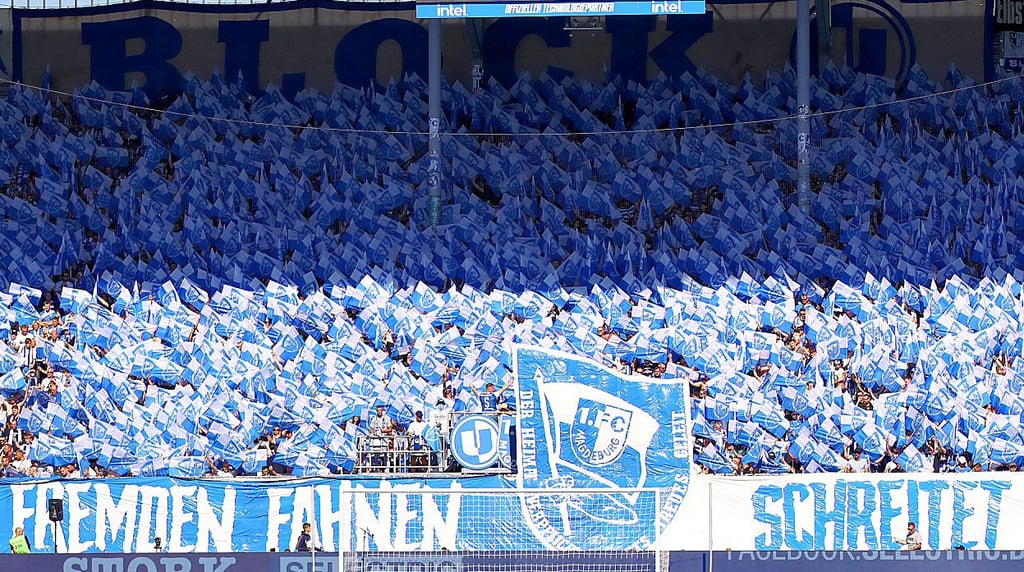 |
| Magdeburg fans in action [ph: volksstimme.de] |
Three-time Oberliga champions Wismut Aue (now Erzgebirge Aue) were a historic side of East German football, staying in the top division basically until the end of it, only relegating in 1989. Between 1954 and 1963 the club was moved from Aue to Karl-Marx-Stadt (now Chemnitz), so technically all three of their league titles as well as their cup title happened while representing Karl-Marx-Stadt.
After the unification Aue began playing in the fourth division, but has climbed up to the 2. Liga in which it has participated 16 times since 2003. The club now plays in the 3. Liga.
 |
| Erzgebirge Aue ultras [ph: fialova-sbor.de] |
Another former champion club is Chemie Leipzig, winner in 1951 and 1964. They contest the Leipzig derby with Lokomotive Leipzig, and both clubs are currently in the Regionalliga.
Leipzig's history is a bit of a turmoil, as the clubs have been merged and disassembled between the 1950s and the 1960s. Chemie was dissolved in 1990, although a new club called Sachsen Leipzig continued its tradition until 2011, so the history passed to today's BSG Chemie Leipzig, founded in 1997.
The derby between the two sides is always tense, as the fanbases hold very different political stances: Chemie fans are mostly leftist and anti-fascist, while Lokomotive ultras are far-right.
 |
| Lokomotive and Chemie Leipzig players wait for the derby to start [ph: en.namu.wiki] |
Another giant club from the former Oberliga are Hansa Rostock: despite spending most of the time in the top tier during the communist regime, Hansa had never won a league title until the last season, in 1991. They have thus played in the first Bundesliga season after unification, but couldn't stay up. They did however spend an entire decade in the top tier over the turn of the century, but they currently compete in the 3. Liga.
According to a 2007 study, Hansa are the seventh most supported club in all of Germany and the most popular in the former DDR, with up to two million fans. The club does however struggle with hooliganism, and like Dynamo Dresden part of the fanbase is politically far-right.
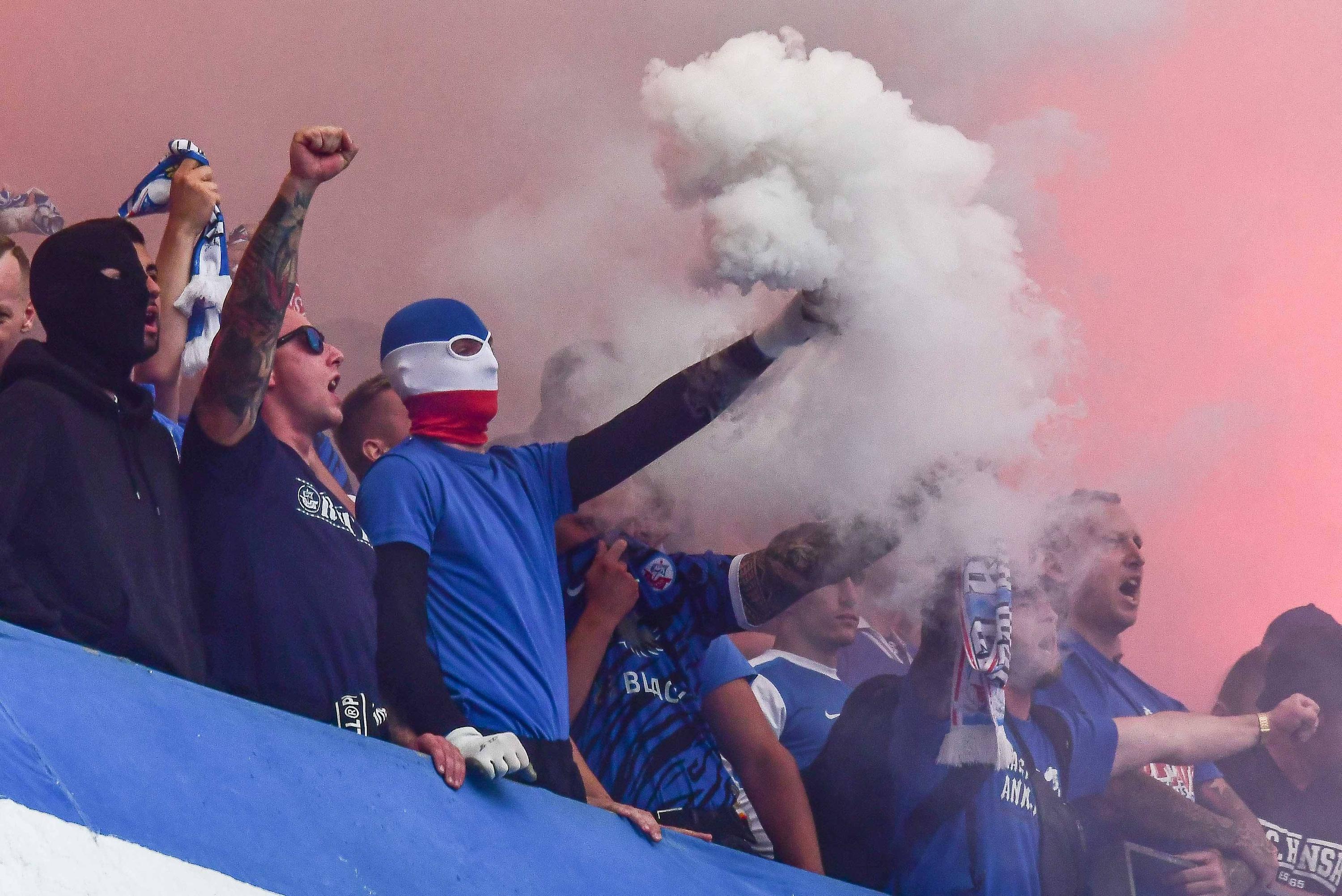 |
| Hansa Rostock ultras create an atmosphere [ph: web.de] |
Energie Cottbus, founded in 1963, have never won a league title but have made a DFB-Pokal final in 1997. They have played six seasons in the Bundesliga in the 2000s, making them one of the most successful East German clubs after the unification.
In recent years they've fallen off a bit, even relegating to the Regionalliga, but as of 2025 they are back in the 3. Liga.
Other relevant clubs from East Germany are FSV Zwickau, twice champions and now in Regionalliga, as well as Chemnitzer, who won the 1967 as FC Karl-Marx-Stadt (after Wismut had moved out) and also play in the fourth tier.
Last but not least, we cover Union Berlin, the current best side from East Germany. As Vorwärts Berlin and Dynamo Berlin were both associated with National entities, politician Herbert Warnke believed that a third club had to be created for the working class of East Berlin, thus Union was founded in 1966 despite the original plan to only have one club per district.
Warnke was the head of the only trade union of East Germany (FDGB), and provided his support to Union for as long as he was in charge. When Harry Tisch, a Rostock fan, replaced him and turned the union's support to FC Hansa, it was clear how much influence powerful politicians had over East German football.
Union won a cup in 1968, but after that the occasional promotion to the Oberliga was the only meaningful success for the club. After unification, the club won its division in 1993 and 1994, but both times their promotion to the 2. Liga was rejected for financial issues. Union was close to collapsing but managed to find sponsorships just in time.
The first promotion to the second tier finally happened in 2001, and history was made in 2019 when they got to the Bundesliga. In 2021 the club qualified for the Conference League, then in 2022 to the Europa League and in 2023 to the Champions League for the first time ever. They only managed two points against Real Madrid, Braga and Napoli, but it was nevertheless a historic result.
 |
| Union Berlin fans filled the Olympiastadion for their Champions League campaign in 2023-24 [ph: fc-union-berlin.de] |
As mentioned at the beginning of the article, the 40 years of division between West and East Germany are clearly visible in all aspects of life, as well as in football. Many of the clubs that have made history for East Germany are now stuck in lower divisions, and while some still managed to have success in the unified nation, it is only a small part of them.
Despite the lack of success, the fans are still very much passionate about their clubs, often appearing excessive in their fandom, but that's a sign of life that can't be killed by a wall. Football in East Germany is alive and well, regardless of the division.
If you're interested in more content about German football, I've covered the 2. Bundesliga, a.k.a. the best second division in the world.
Another similar article (and one of my own favourites) is the one about the other clubs from Paris, check that one out!
Comments
Post a Comment