May 22nd, 1988. Matchday 38 of the Segunda Division, second minute of stoppage time, Deportivo La Coruña - Racing Santander is on its way to finish as a goalless draw, and as it stands the home side is set to relegate to the Segunda B, the third tier, which would be a catastrophic result as the club is already struggling to make ends meet. Every last bit of hope is based on the knowledge that at the same time Bilbao Athletic, Depor's relegation rivals, are two goals down in Jerez and only one point ahead of them in 16th place, the last position that guarantees safety from relegation. The galicians are throwing everything they can at Racing's defense, cross after cross, shot after shot, saves, deflections, potential handballs, but never the chance they are waiting for. But as we said, second minute of stoppage time: corner from Depor's attacking left side, a defender heads it away on the opposite side of the pitch, but a second ball ends up in Racing's box: Vicente Celeiro is there, at the right place and at the right time, just on side, and is as composed as you can be. Shot in the bottom right corner, the keeper has no time to react from so close, goal. 1-0. El Riazor erupts in joy, Depor jump to 31 points in the standings, but most importantly they jump Athletic Club's second team for 16th place and earn safety. In retrospect, this was the moment that gave birth to Super Depor.
As we said, this goal was crucial and probably saved the whole club, but such risks could not be ran anymore: the massive relief for Celeiro's goal did not cancel the fear that fans in La Coruña had felt just moments before, so it was important to avoid any type of risks in the future. The team managed the task greatly, as they finished midtable in Segunda Division the following year, but the main result from the 1988-89 season was the first deep Copa del Rey run from the blue and white boys: from the first round with Arenteiro, then As Pontes, then Real Sociedad's B team, then Sabadell, then Real Sociedad's main team, then Mallorca. An infinite amount of Copa rounds won, but only Real Valladolid could stop them in the semifinals.
In 1990 another step forward is made: Depor finish fourth but miss out on promotion as they lose 1-0 to Tenerife in the playoffs, but at this point it's undeniable that the club is growing and moving in the right direction. The Galician club will only have to wait a year to have another shot at promotion: the following league season's promotion fight reaches the final matchday with four clubs in contention for the top two spots, which guarantee the rise to the top tier. Real Murcia, who have led the league from matchday 3 onwards, still leads the way going into the last matchday with 48 points, Albacete follows with 47, then come Depor and Malaga with 46 and 45. Albacete only need to beat 18th placed Salamanca to start the party, Malaga must beat Eibar and hope for a miracle, while Deportivo and Murcia will play each other in a match that shapes up to be a promotion final.
A day supposed to be full of joy, at least for one of the two teams at the Riazor that day, starts in the worst possible way: a massive fire burns through the roof of the stand of La Coruña's stadium. Luckily there's no casualties, so the match can begin normally despite the scary incident. By half time no team involved in the fight has scored yet: the first team to strike are Deportivo themselves, with Zoran Stojadinovic turning the score in favour of the home side. Meanwhile Albacete strike twice to take a comfortable 2-0 lead and possibly one of the two promotion spots. Malaga are still goalless but Albacete's win means they are out of the fight anyway, so the whole attention can go to Deportivo-Real Murcia, where Deportivo must at all costs win to secure promotion and Murcia must at all cost equalize to go up themselves. The contest has little time left though, as Stojadinovic scores again to send the Riazor in chaos three years after Celeiro's famous goal. With two goals of advantage the fight is finally over, Albacete and Depor have won, and Galician fans can celebrate promotion back to the Primera Division for the first time after 18 years.
The first year back in the Primera Division was always going to be tough, but the club managed to avoid relegation winning the playout against Betis, gaining safety and the chance to build from there. And so they did: the 1992-93 sees Depor finish third behind only Barcelona and Real Madrid, the best finish in the top flight since 1950, earning an incredible qualification to the UEFA Cup. Brazilian striker Bebeto even becomes the first player in Deportivo's history to win the Pichichi, scoring 29 goals. Now came the time to confirm the team's power, to show that they did not just have one lucky season and that they could fight for the title along Spain's giants.
Super Depor did in fact put on a title fight in 1994. Leading the league until late in the season, they paid the price of a couple too many draws towards the end of the campaign. On the final matchday a win would be enough to secure the club's first ever league title: the opposition is Valencia, who are comfortably 7th and outside of any fight for European competition access. Depor however do not manage to score, and even have a penalty towards the end of the game to do so: Miroslav Djukic misses, leaving everyone at the Riazor heartbroken.
1994-95 saw Super Depor finally earn its first piece of silverware: second in the league behind Real Madrid, they faced Valencia at the Bernabéu in the Copa del Rey final. Facing the same team that denied them the league title the year prior, the match was suspended for heavy rain with the score of 1-1. When the match restarted three days later, Alfredo Santaelena scored the decisive 2-1 goal, and Depor held onto the lead to win the cup in unusual circumstances. Legendary manager Arsenio Iglesias, nicknamed The Wizard of Arteixo for the incredible results he reached with Depor, retired at the end of the season after 11 years as the manager of the club over four different spells.
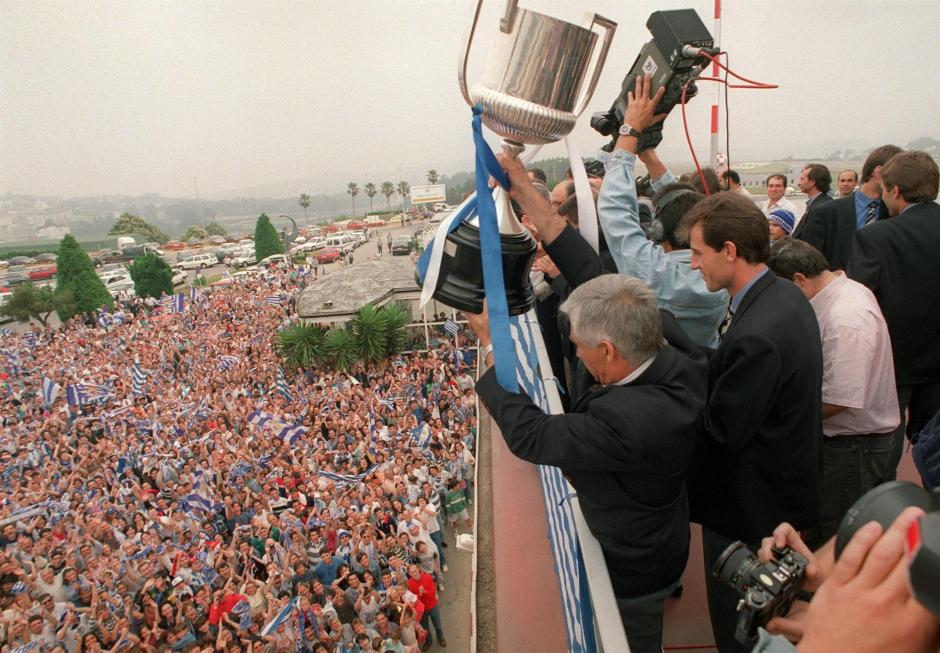 |
| From eldebate.com |
After Iglesias retired the club had alternating success for a couple years, winning the Spanish Supercup, qualifying again for the UEFA Cup and then finishing 12th in 1998. It wasn't until 1999-2000 that Depor managed to put on another title fight: the team led by Pauleta, Fran, Mauro Silva, Donato, Flores and Maakay looked strong from the beginning. From matchday 12 onwards Deportivo led the league and never looked back, and despite losing a crazy 11 matches in La Liga alone, they still held on to the lead until the end and finally won their first ever league title on the last matchday, beating Espanyol 2-0.
Real Club Deportivo de La Coruña were finally champions, a feat that in Spain had only been achieved by eight other clubs before them. This was by far the biggest achievement in Depor's history, and the fact that it has come after years of close calls just shows how good the team was in those years: it was not a lucky season, Deportivo just built a team that could go toe to toe with Barcelona and Real Madrid over multiple seasons. This fact was then reinforced in the years following the league title: Depor were runner up in the following two seasons as well and came 3rd a couple times more, they reached the UEFA Champions League quarter finals twice and most importantly won one more Copa del Rey and two Supercups.
The last great achievement of the Super Depor era was 2003-04: the team came third in the league, but cemented it's place in European football history with a deep run in the Champions League. Drawn in a group with AEK Athens, PSV Eindhoven and AS Monaco, Depor starts the group stage well, earning 7 points in the first three matches. The lowest point of the campaign came in November away in Monaco: in a historic match Depor was on the wrong side of a massive thrashing, scoring three but conceding an incredible eight times. This match kept the record for most goals in a single match until Borussia Dortmund beat Legia Warsaw 8-4 in 2016. Nevertheless, the club qualified for the knockouts because of positive head-to-head results against PSV, but drew Italian giants and 2003 finalists Juventus in the round of 16. Despite their rivals' European pedigree, Deportivo won both legs 1-0 thanks to goals from Albert Luque and Walter Pandiani and advanced to the quarter finals once again.
This time, the opposition were AC Milan, the current champions who had beaten Juventus in the final in the previous season. The first leg at the San Siro started well for the Galicians, with Pandiani once more hitting the net and opening the scoring in the 11th minute. The star-filled red and blacks fought back hard though, scoring four times between the 45th and the 53rd thanks to a Kaka double and goals from Shevchenko and Pirlo. A heavy 4-1 defeat in Italy meant Depor needed a miracle in the second leg in La Coruña, but yet another early goal from Pandiani gifted los Herculinos the little bit of hope they needed to give AC Milan a run for their money. A second goal from Valeron in the 35th minute put Depor just one goal away from a winning position, which was unthinkable just half an hour before, and when Luque scored their third just before halftime the Riazor erupted. Deportivo and AC Milan were now tied 4-4 on aggregate, but the Spaniards would be going through on away goals. Milan desperately needed a goal that never came, and when Fran scored a four for Depor in the 76th the fans could just feel the semifinal come for the first time in their history. The blue and whites held on to an unbelievable 4-0 victory against what was the strongest team at the time and wrote history once again.
For their first ever Champions League semifinal Deportivo had to take on Jose Mourinho's FC Porto. The first leg at the Estadio do Dragao was a tense 0-0 draw, but when Porto scored through a penalty in the second half of the second leg, Depor finally found a hill too steep to climb, needing two goals to overcome the away goals rule. The goals never came, and Deportivo's best ever Champions League campaign came to an end just one step before the final.
Just as Celeiro's goal in 1988 may have started the era of Super Depor, this European run may have been the last episode of this club's most glorious era. The following years midtable finishes were the norm, until relegation came in 2011, after 20 straight years in the Spanish top flight. The club yo-yoed between the Primera and the Segunda Division for a couple years, until in 2020 they fell back to the third tier for the first time since 1981. Depor just recently earned promotion back to the Segunda Division in 2024, and are currently fighting to avoid relegation. The Galician faithful must surely be hoping that safety in the Segunda Division will once again be the start of something great.
Comments
Post a Comment