From its beginning in 1960 until the 2018 edition, the Copa Libertadores' final has been decided by two-legged ties, making it significantly different compared to the typical one-legged Champions League final held in a neutral venue. South American football is well known for the strong influence of the home crowd over the match. For example, Bolivian clubs and the Bolivian national team have a massive advantage when playing their home matches against opposition from other parts of the continent because of the extreme altitude at which the country is located, and in particular its capital La Paz, which stands at 3,640 metres above sea level (almost 12,000 feet). Apart from geographical differences of the various South American locations, the two-legged final also gave both finalists' the chance to host one of the two matches at their own stadium in front of their own fans, who would fill up the ground to its limit and sometimes even beyond it to witness the biggest possible continental match played by their heroes.
The two legs were going to be abolished in 2019, as CONMEBOL tried to copy the Champions League's approach in an attempt to make the final more spectacular and more watched worldwide. This revolution had the effect of making the following finals feel less special and less South American, but this is an issue for another time. Today we're going to take a look at the 2018 Copa Libertadores edition, the last one with a two-legged final.
/origin-imgresizer.eurosport.com/2018/11/11/2460091-51100530-2560-1440.jpg)
As every club across South America participating in the biggest continental competition knew, 2018 was going to be their last chance to reach the final and play half of it in their city, in their own ground and in front of their own fans. All of the biggest Uruguayan, Brazilian, Argentinean teams wanted to take up this chance, and the group stages were a bloodbath. Both Uruguayan giants, Nacional and Peñarol, crashed out and were relegated to the Copa Sudamericana, the South American equivalent of the Europa League, as well as fellow countrymen Defensor Sporting. Of the 16 clubs qualifying for the knockouts, 12 were either from Argentina or from Brazil, equally split between the two nations, and the remaining four were Libertad de Asuncion and Cerro Porteño from Paraguay, Atletico Nacional from Colombia and Colo-Colo from Chile, so hardly any surprise happened in the group stages as all the continental giants kept marching on towards La Gloria Eterna, "the ethernal glory" that the players would earn if they won it all.
The first knockout round saw Brazilian giants Flamengo and Santos eliminated at the hands of Cruzeiro and Independiente, with Superclasico rivals Boca Juniors and River Plate comfortably going through, beating Libertad and Racing Club. Colo-Colo also went through, beating Corinthians on away goals and remaining the only club outside of Argentina and Brazil still in contention, although their journey would end right after at the hands of Palmeiras. In the other quarter-finals Gremio, Boca and River went through at the expense of Atletico Tucuman, Cruzeiro and Independiente. The semis were set, with two massive ties between Argentina and Brazil: River Plate were to face Gremio, and Boca Juniors had Palmeiras in their path.
With such semifinals, everyone started imagining what a possible final could look like. A brazilian derby? Yet another brazilian-argentine matchup, after Gremio beat Lanus just the year prior? Or the most unique hypotesis of all, a Boca-River final that had never happened before? This last possibility took a hit on October 23rd, as Gremio beat River 0-1 at the Monumental in the first leg of their semifinal. The day after, Boca put a foot and a half in the final as a Pipa Benedetto brace in the final few minutes put the Xeneizes two goals in front of Palmeiras going into the second leg at Allianz Parque in São Paulo.
On the following week the second legs took place: River had to overcame a goal of deficit in their trip to Porto Alegre, but things took a scary turn when Gremio once again netted first through Leo Gomes. As time passed the sight of a Superclasico final started to seem more and more unlikely, until Rafa Santos Borré equalized in the 81st minute, sparking a light of hope for the Millonarios faithful. Just a couple minutes later, the miracle happened: Ignacio Scocco tries a shot at goal but the ball is deflected and referee Andres Cunha awards the away side a corner kick. Something's not right though, and VAR assistants recommend the referee to have a closer look: Gremio defender Bressan clearly deflected the shot with his hand, and a penalty kick is rightfully awarded. The minutes that followed were pure chaos: Bressan aggressively charged at the referee when he got his second yellow card, and play didn't resume until the penalty was kicked by Gonzalo Martinez in the 94th minute. River were now through on away goals and one man up, and held on for the whole 13 minutes of added time to defeat Gremio and reach the final.
It was now Boca's turn to get the job done: Ramon Abila scored early to give the visitors a 0-1 lead in the match and a 0-3 lead on aggregate, but Palmeiras weren't dead yet and pulled two goals back at the start of the second half through Luan Garcia and Gustavo Gomez. Just minutes later though Benedetto found his third goal of the tie to level the score at 2-2, and the two goal cushion was reestablished and kept until full time.
So, that was it. For the first time ever, a Superclasico would award an international trophy, the most important of South America. The whole attention of Argentina, South America and the whole football world would turn to Buenos Aires to see which of the two sides would conquer ethernal glory and which would suffer ethernal pain.
The two legs were originally scheduled for the 7th and 28th of November, both on Wednesdays. After the finalists were known though CONMEBOL changed the dates to the 10th and 24th, both Saturdays and with both matches hosted at 5pm. The first leg, to be hosted at Boca Junior's famous Bombonera, was delayed because of the pitch being waterlogged due to floods that had hit Buenos Aires, so it was played on Sunday instead.
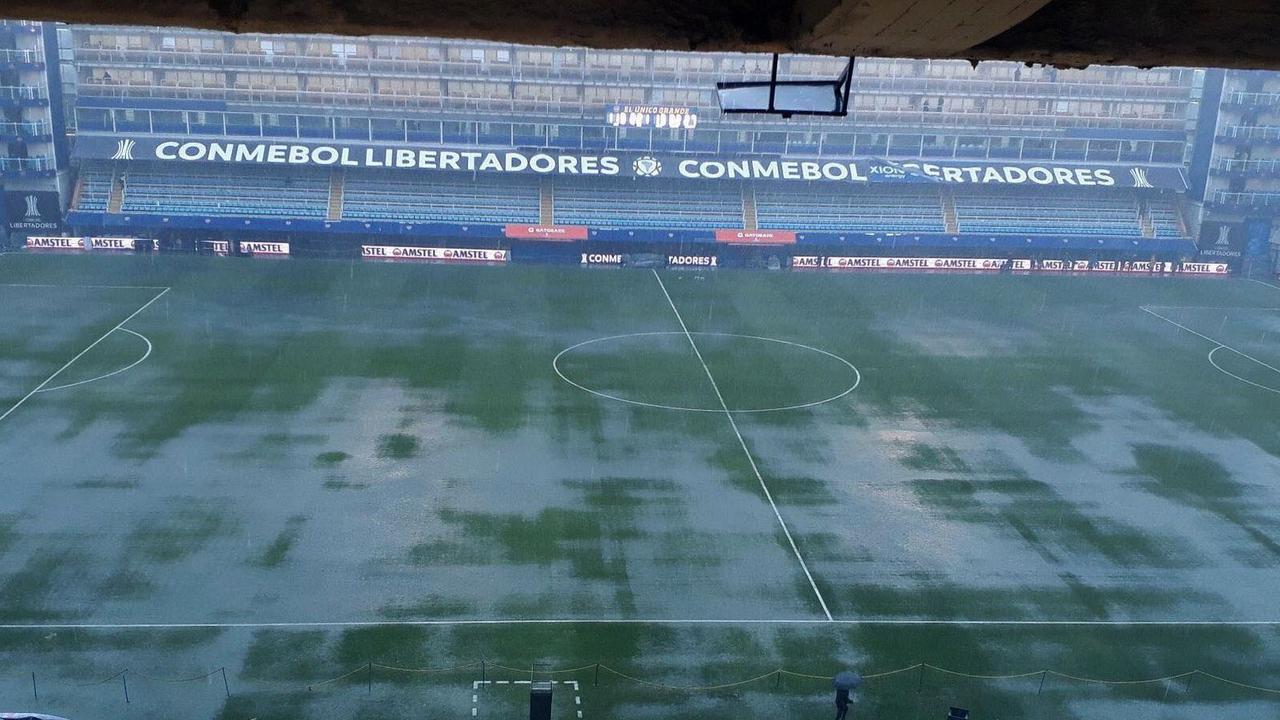 |
| The Bombonera pitch flooded. From foxsports.com |
In front of the most obviously sold out crowd ever, Boca and River produced a great spectacle for neutrals, with River wasting a couple chances before Boca found the net through Abila once again. Just one minute later though Lucas Pratto was through in front of Agustin Rossi and made no mistake to equalize the tie right away and silence the Xeneizes. River kept attacking and had a couple chances more to get the lead in the first half, but it was Benedetto instead who in injury time of the first half made La Bombonera erupt once more. The second half was as balanced as the first, with the only goal, River's second, coming in a similar manner as Benedetto's, this time with Izquierdos producing an unfortunate own goal. The first leg ending in a draw meant that the incredible tension felt throughout the city would not release until the second leg, as River Plate fans were eager to take full advantage of being the home side with the trophy on the line.
River fans' willing to make the Monumental hell for the historic rivals took a dark turn in the hours prior to the second leg: some fans attacked Boca's team bus as it was heading towards the stadium, surrounding it and breaking its windows with stones. As a result of the broken windows, pepper spray also made its way into the bus, leaving several players injured because of the glass and the spray. The match was originally delayed by one hour, but multiple more delays made the authorities inevitably decide to postpone the match and reschedule it on the following day, the same decision that was made for the first leg although for much tamer reasons.
The following day, after Boca officials requested for the match to be postponed to be sure that the match would be played in "conditions of equality", as the club stated in an official note. As a result of this, CONMEBOL could not guarantee safety at the stadium and for the Boca squad, so the match was, once more, postponed. A few days later the South American federation finally announced that the match had to take place outside of Argentina due to safety concerns, and then confirmed that it would be played at Madrid's legendary Santiago Bernabéu on December the 9th. For security reasons away fans had been banned from both ties in the original plans, but for this particular situation five thousand tickets had been allocated to each club, although Real Madrid ended up selling 25 thousand tickets to fans of each team, with tens of thousands of them being Argentines that lived in Spain, and the rest to its season ticket holders, which sold out quickly.
 |
| Boca Juniors and River Plate line up at the Bernabéu. From nordicstadiums.com |
So, in a unique situation, in a different country and with a never seen before Superclasico, the last ever, and possibly longest ever, Copa Libertadores two-legged final was about to award one of the two Argentine giants their most important success ever, and to the other their worst loss.
On the 44th minute it was once again Benedetto, through one on one against Franco Armani, gifting Boca a precious 1-0 half time lead below the stand populated by the yellow and blue coloured fans. River came out of the dressing room to fight back though, and after much trying they finally equalized with a great piece of team football, as Pratto finalized the move and canceled Boca's lead just as he had done in the first leg. With tensions rising even higher than it was thought possible, and little emotions apart from a penalty shout from Boca's squad, regular time ended in a draw, so extra-time was needed to decide who the champions of South America would be.
The added 30 minutes started terribly for the technically-away side Boca, and after just two minutes Guillermo Barros Schelotto's men were down to 10 men as Wilmar Barrios earned a second yellow after a hard challenge in the middle of the pitch. On the other hand, being a man up definitely made River's tiredness disappear, with the thought of winning the biggest game of their lives starting to be more than a dream. Boca could hold the draw for the whole first half of extra-time, but after a few minutes of the second half Juan Fernando Quintero wrote his name in River's history, scoring an absolute beauty from outside the box that kissed the crossbar and hit the net behind Esteban Andrada. A goal down and a man down, things just kept going downhill for Boca Juniors: they remarkably kept attacking with great intensity to find an equalizer, but Fernando Gago going down injured meant they had to do so with only 9 men on the field. To make matters worse, Leonardo Jara hit the post for Boca in the last minute of the match, with a shot that would have made Boca's side of the Bernabéu collapse in joy.
In the 122nd minute, with everyone in River Plate's box as Boca had a last desperate corner kick to somehow find a goal, the ball was cleared and nobody was there to defend the goal anymore, and el Pity Martinez ran the whole length of the field by himself to score the easiest and most important goal of his life. It was 3-1, River was out of Boca's reach now, the Millonarios were champions of South America and had defeated their most hated rival in their biggest ever derby.
Seven and a half years after River Plate's disastrous relegation to the Primera B, they were, once again after the 2015 triumph, on top of South American football, but this time against the archrivals was possibly a thousand time sweeter for the Millonarios.
As football keeps moving forward, this episode gifted River fans the best reply to Boca's accusations of being the lesser club because "descendieron a la B" (they were relegated to the B league): "Boca muriò en Madrid", and Argentina's biggest rivalry will stay alive for decades more, fueled by idioms and banter - possibly just those and no violence anymore.
Comments
Post a Comment