The empire on which the sun never sets is a well known phrase used to describes empires so large that it's always daytime on at least a small part of it. It was the case of the British Empire, which got so big that it had dominions over every single continent on the planet. The idiom, however, describe well enough the concept of an empire that is incredibly large in terms of longitude, so on the east-west axis. What about the latitude? I have no clue, and the British Empire is not a thing anymore, but the United Kingdom still covers a large amount of land and islands and Shetland, or the Shetland Islands, is the northernmost part of it.
This archipelago of about 100 islands, only 16 of which are inhabitated, sits in the middle of the North Sea, between Orkney, the Faroe Islands and Norway. It hosts a population of 23,020 people, most of which live on Mainland, Shetland's biggest island. Because of it's position clear winter nights sometimes allow the sight of the northern lights, while in the summer there's the famous simmer dim, which translates as "the twilight of a Shetland summer evening", as being so far north makes some days so long that the sun doesn't set until midnight and rises back up shortly after.
 |
| The simmer dim. From scotsman.com |
While this particular sunset-sunrise cycle seems to be an extraordinary spectacle to witness, summer in Shetland also means football: as with all other places in the arctic circle or close to it, winter isn't that favourable for outside sport activities. The Shetland Football Association is affiliated to the Scottish Amateur F.A. and has two different divisions, a 7-team A League and an 11-team Reserve League.
Participating in the A League are three clubs from Lerwick (Celtic, Spurs and Thistle), alongside Ness United, Scalloway, Whalsay and Whitedale. These seven clubs compete for seven different trophies over a season. The Ocean Kinetics Premier League is the main competition, it's a traditional league in which every club plays against everyone else twice, once at home and once away, and runs from May through to August. The Highland Fuels Cup is a cup competition played in April by the seven A League clubs and one club from the Reserve League.
The Northwards Manson Cup, the Jewson Madrid Cup, the Bolts Car Hire Fraser Cup and the GTS County Shield are all cup competitions and are played one after the other throughout the season. The last piece of silverware, the Laurenson Cup, is given to the winner of a match between the champions of the previos Premier League and the current Shetland Select Team.
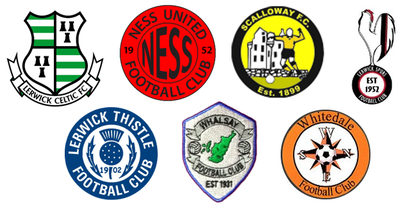 |
| The seven clubs part of the A League |
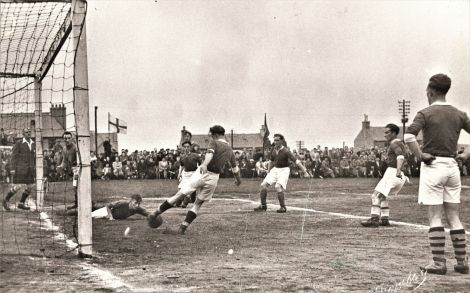 |
| From shetnews.co.uk |
A team representing Shetland regularly plays matches in other counties, and playing with the blue kit is the biggest honour for the young shetlanders that fall in love with the beautiful club growing up. The main rivalry is with aforementioned Orkney, with whom Shetland competes every year for the Milne Cup in a fixture that both regions always attend in big numbers. Shetland's selection also competes in the International Island Games, and even won the gold medal the 2005 football tournament on their own ground in Lerwick in a 0-2 win against Guernsey in front of 5000 spectators! This triumph has been reported by the BBC as "the biggest shock in island games football history", as Shetland had never reached a better result than 7th place in the tournament but managed to win it all and spread incredible joy throughout the archipelago.
As with most remote places football in the Shetland Islands is fueled by the passion of its inhabitants: where massive TV deals, shiny new stadiums and multi-millionaire teenagers aren't a thing, the beautiful game relies on the effort of crucial volunteers who make everything move forward and gift us these incredible stories with their hard work.
Comments
Post a Comment