Belfast, as capital city of Northern Ireland, has for centuries been plagued with tensions between the Protestant Unionist and the Catholic Republicans. Such a tricky cohabitation has seen the city become theatre of plenty of violent incidents, political unrest and deeply rooted hatred between the two factions, creating a similar environment to that of Glasgow, which has seen Celtic and Rangers grow into one of the most notable pair of rivals on the planet.
As it does to this day in Glasgow, football also played a role in Belfast, partly taking inspiration from its Scottish counterpart. In 1891, four years after the founding of Celtic FC, the Catholics in Northern Ireland founded a club of their own and named it Belfast Celtic, adopting the same name and colours of the Scottish side.
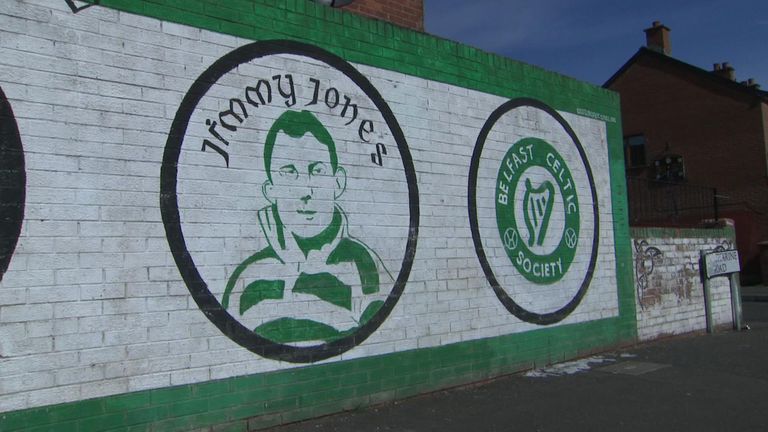 |
| The Celtic mural in Belfast [sky.com] |
Quickly becoming a pillar of the Catholic communities of west Belfast, the club started achieving success at the turn of the century, winning its first league title in 1900 beating what had become their fiercest rivals, Linfield, by a single goal.
Linfield, a Protestant club, have in history repeatedly been accused of being sectarian, both due to its alleged employment policy (a never confirmed rule to never sign Roman Catholic players) and due to its own fans repeated violent anti-Catholic behaviour.

Action between Linfield and Belfast Celtic in 1934 [Bolo Editing]
Political tensions have been ever present in Belfast Celtic's history: when the Irish War of Independence broke out in 1919 the violence spilled onto the terraces of the Irish football league, and at times even on the pitch. An incident in the 1920 Irish Cup semis forced the Irish FA to fine and suspend the club, which then decided to abandon the season deeming the risk of further incidents not worth it. Only in 1924, four years later, the club rejoined the Irish League.
Amidst the conflictual relationship between Belfast Celtic's mostly Catholic fanbase and their Protestant rivals, the Celts dominated the league in the inter-war era, winning 10 league titles between 1926 and 1940, along with countless Irish Cups, City Cups, Gold Cups and more local competitions.
The massive amount of success made Belfast Celtic the pride of Northern Irish Catholics, which saw them as a beacon of hope in a country that forced them into a systematic position of disadvantage under British rule.
 |
| Scotty Walker, Jackie Vernon and Charlie Tully admire the silverware they've conquered [belfastceltic.org] |
The day Belfast Celtic died
The tensions would, however, exceed any limit once more on a Boxing Day derby against hated rivals Linfield in 1948. The two clubs where at the top of the table, with Linfield leading Belfast Celtic by three points, so the two points of a possible victory were absolutely crucial for both clubs in the title fight.
The match was a brutal affair: the hate between the two sets of fans also influenced the behaviour of the players on the pitch, and by the time the first half was over Linfield was down to nine men already. That happened not due to red cards, but because two injured players, who suffered a fractured leg and rib injuries, couldn't be substituted at the time.
As the second half came along, two more players were forced to leave the pitch, one for each team, this time ordered off by the referee. As the match was approaching the end, Celtic were given a penalty which they converted to take a 0-1 lead, but Linfield managed to equalise in the final minute.
The Protestant Linfield fans, some filled with adrenaline for the late goal and some filled with the hatred for their counterparts, stormed the pitch and began attacking several Celtic players.
Jimmy Jones, Celtic's star forward, was the main aim of the attack, accused of being a traitor because he was a Protestant playing for a Catholic club. He was thrown over a parapet, kicked unconscious and left with a broken leg. Robin Lawler and Kevin McAlinden were also hurt by the attacks.

A piece on the Irish Independent about the match
Controversies didn't stop at the incident. Linfield stated that the pitch invasion happened because of multiple provocation from the away players, while on the other hand Celtic blamed both Linfield and the police, accusing them of doing nothing to prevent the attack nor punish the aggressors.
Judging the response of the Irish FA as inadequate given the circumstances, the club management held a meeting that same night to decide the future of Belfast Celtic. Feeling they had no other option, they opted to withdraw from the Irish League at the end of the season. As journalist Frank Curran commented, "they knew it wasn't a football problem, and there was nothing they could do to end it, so they got out".
The American tour
Belfast Celtic played their last ever league match on April 21, 1949, defeating Cliftonville 4-3. After that, they went on a tour in North America to play in front of the thousands of Irish immigrants who had left the country. They were welcomed as Irish heroes by New York City mayor William O'Dwyer, who was born in Ireland himself.
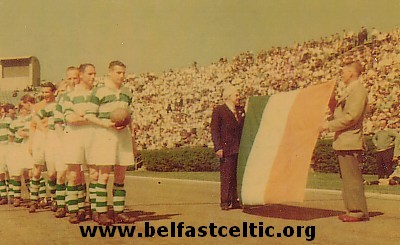
While on tour, the club caused uproar in Northern Ireland. The Belfast Telegraph published a picture of the players marching behind an Irish flag in New York City, and Northern Irish Unionists didn't take the news well, accusing the players of being traitors. To reduce tensions Celtic's manager Elisha Scott, who was Protestant himself, was forced to write a letter to explain the incident and reassure everyone of the team's loyalty to the United Kingdom.
Belfast Celtic players parading in front of the Irish flag [belfastceltic.org]
The most famous match of the American tour for Belfast Celtic was their encounter with Scotland. According to the New York Times the crowd largely supported the Scottish side, which was also heavily favoured to win the match after they had just defeated England at Wembley a month prior.
Celtic scored straight away in the first half and doubled their lead in the second half, and then fights broke out, with players even exchanging punches. Despite the hostile environment, the Northern Irish side won 2-0, conquering one of the most memorable successes of their history.

Celtic players line up alongside the Scottish National team [belfastceltic.org]
When the tour finished, the club sold all its players and left their spot in the league without giving fans any official explanation. Jimmy Overend, a Celtic fan, explained what west Belfast felt when they got the news that their club had disappeared: "it was like a black cloud coming down, as if there was nothing to live for or look forward to on a Saturday. It's a grief which never went away."
Jimmy Jones - the legendary striker
Jimmy Jones was just 20 years old when he suffered a broken leg in the Linfield incident. He had surgery to save his leg, but that left his right leg a bit shorter than the left, and he would not play a football match for more than a year after that. When released by Belfast Celtic in 1950, he had scored 102 goals in 80 matches for the club.
In 1951 he signed for Glenavon, where he would play 11 years and score 517 more goals, becoming a legend of not only Northern Irish football but world football as a whole. According to IFFHS he's still the 8th most prolific goal scorer in football history, with 639 goals in total, behind only Cristiano Ronaldo, Messi, Pelé, Romario, Puskas, Bican and Lewandowski.

Jimmy Jones at the unveiling of his portrait in Belfast [belfastceltic.org]
The Belfast Celtic Society
In 2003 the Belfast Celtic Society was formed to keep alive the memory of a great club that once was a central piece of the Catholic community in Belfast. They have set up a Belfast Celtic Museum in Belfast to showcase Celtic memorabilia.
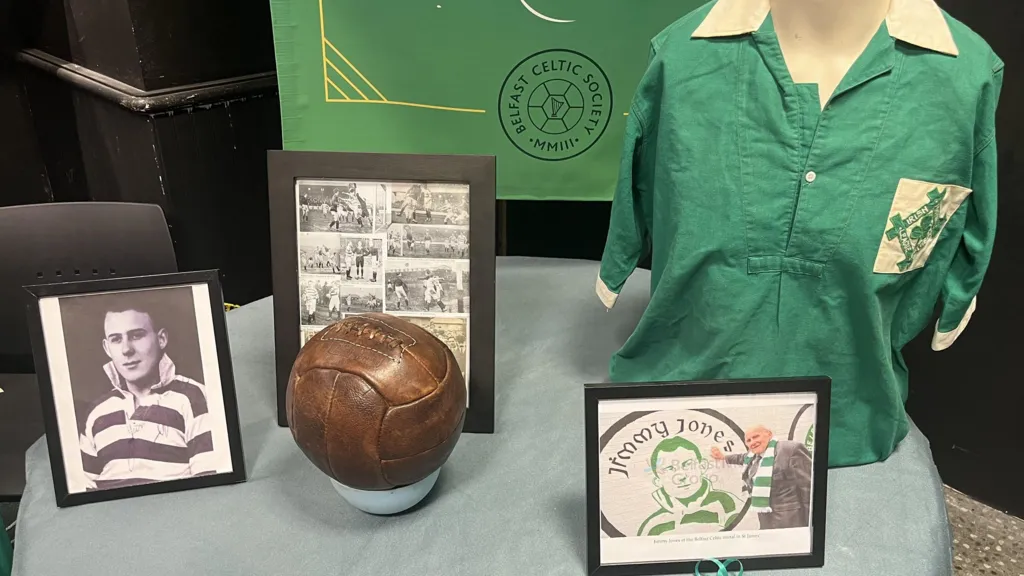
Jimmy Jones memorabilia displayed at the Belfast Celtic Museum [bbc.com]
Despite the club leaving the Irish
League in 1949, Belfast Celtic is still a part of many people's lives.
This is thanks to the memories they've gifted to their fans, who have
then passed the stories down the generations so that those who weren't
fortunate enough to attend the games at Celtic Park could know the
legacy of the Grand Old Team.
Comments
Post a Comment