Didier Drogba and his teammates from the Ivorian National team helped temporarily stop a civil war by delivering a message on live television.
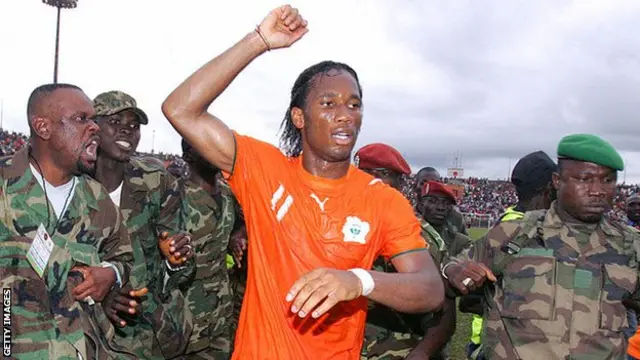 |
| Didier Drogba surrounded by military men after a home match for Ivory Coast [Getty Images] |
West Africa is a region marked by remarkable cultural diversity and deep historical roots, and as a result it is home to a complex mixture of ethnicities, languages and religions. This background has created a political landscape just as complicated, which unfortunately often causes terrible civil wars that tear apart entire countries and their communities. Prime example of that are the wars in Sierra Leone, Liberia and the still ongoing rebellions in Mali.
Ivory Coast suffered the brutality of internal conflicts as much as its neighbors. Felix Houphouët-Boigny, the country's first president after the independence, ruled the country for over 30 years, and under his leadership there was unprecedented stability and economic growth, to the point that this period was later named Ivorian Miracle.
 |
| Felix Houphouët-Boigny, Ivory Coast's first president [samepassage.org] |
Houphouët-Boigny was tolerant of immigrants from Mali and Burkina Faso, mainly because they worked on the plantations and thus helped the Ivorian economy greatly. When he passed away in 1993, the power vacuum led to tensions between Bédié and Ouattara, who were respectively the constitutional successor of the president and the former Prime Minister.
Béidé introduced the concept of Ivoirité, questioning the nationality of people from the northern regions of the country as well as Muslims, marginalizing millions of people including his political rival Ouattara, who had Burkinabé ancestry, thus banning him from running for president in 1995 and 2000.
In 1999 a coup led by General Robert Guéï overthrew Bédié's government. Guéï staged elections, but lost to Laurent Gbagbo and had to leave the country. In the meantime, the people from the north felt abandoned because their candidate, Ouattara, was not allowed to participate in the election, and tensions between the two extremes of the country kept rising because of this.
In 2002 a rebellion broke out, and the Force Nouvelles, the rebels from the north, took control of the city of Bouaké and basically the top half of the country, effectively splitting Ivory Coast in two.
Between the occasional peace agreement and recurring clashes and escalations, the Ivorian National football team was witnessing its best generation of footballers yet make their way to the top of the European game. Kolo Touré, Emmanuel Eboué, Didier Zokora and most importantly Didier Drogba were making a name for themselves, and the guidance of French manager Henri Michel had led the National team within touching distance of its first ever World Cup appearance.
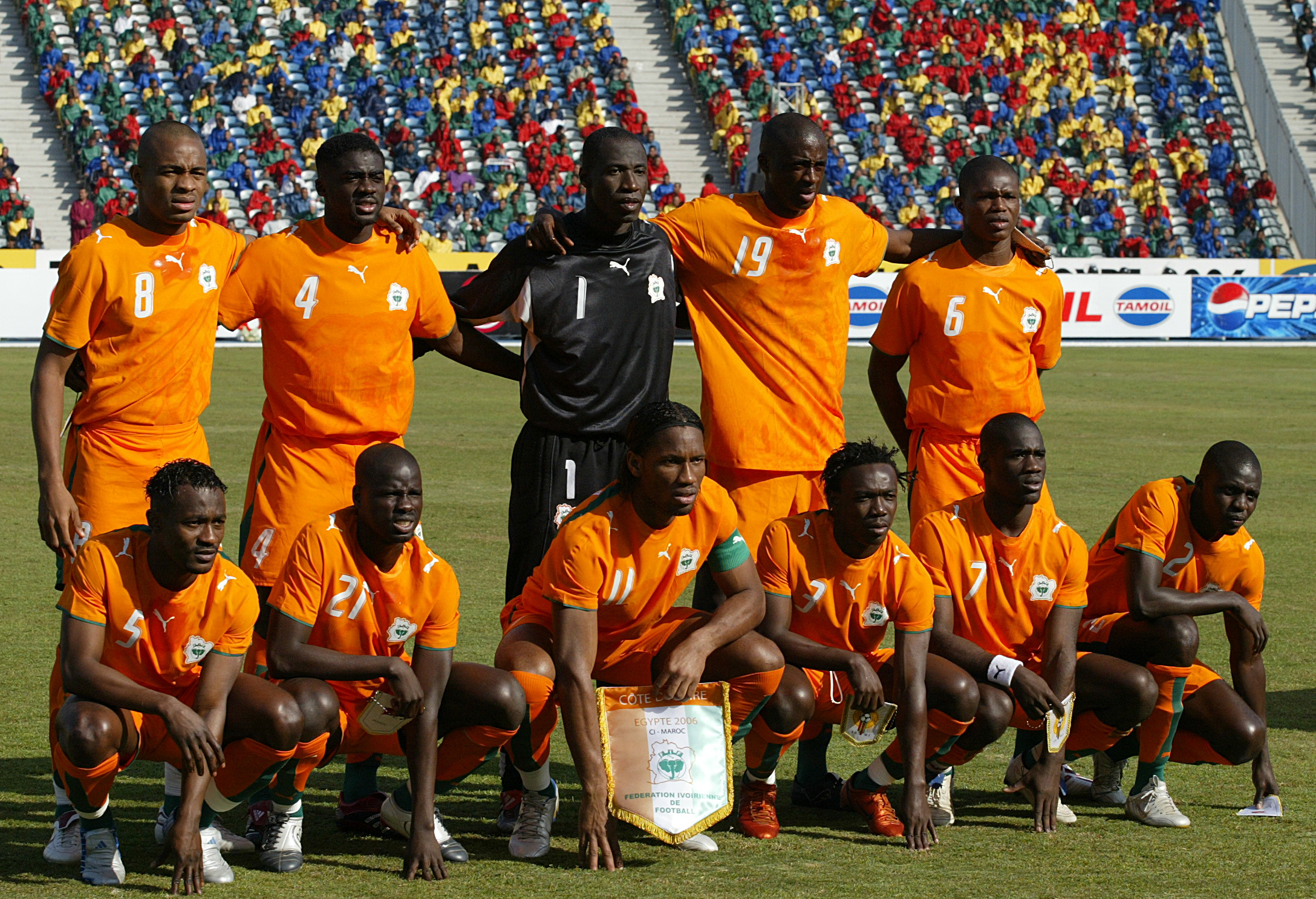 |
| The Ivorian National team [Getty Images] |
On October 5th, 2005, the Ivory Coast had to defeat Sudan and hope Cameroon wouldn't beat Egypt to win earn a spot in the 2006 World Cup in Germany. The Ivorians easily took care of their opponents, Kanga Akalé opened the scoring and Aruna Dindane's brace in the second half earned them the victory, before Sudan's consolation 1-3 goal.
The country's attention could now turn to the other match, where Cameroon led by a goal until Mohamed Shawky leveled for Egypt in the 79th minute. This goal would be enough for the Ivorians, but Cameroon won a penalty in injury time and any hope of qualification seemed over.
Pierre Womé steps up for the Indomitable Lions, but his shot is too wide and hits the outside of the post.
 |
| Pierre Wome shoots his penalty against Egypt [shutterstock.com] |
This one single miss left Cameroon in despair and Ivory Coast in incredible joy, as they qualified for the World Cup for the first time ever, and possibly felt as one united Nation for the first time as well.
The most memorable moment of that day did not happen on the pitch though. In a small locker room in Al-Merrikh Stadium in Omdurman, Sudan, the heroes that had just made Ivory Coast the happiest they had ever been had a message for the whole Nation. They delivered it through the voice of their superstar striker, Didier Drogba:
Ivorians, men and women, from the north, south, center and west.
We proved today that all Ivorians can live together, play together, share the same goal - to qualify for the World Cup.
We promised you that the celebrations would unite the people.
Today we beg you, on our knees...
Forgive. Forgive. Forgive.
One country in Africa, with so many riches, must not sink into war.
Please lay down your weapons.
Organize elections, and everything will be better.
This scene, with the players huddled together and then on their knees, begging for the civil war to stop, was replayed over and over again on the Ivorian televisions for days. The exposure this message got had the effect of moving the two sides closer, allowing them to negotiate and finally sign a ceasefire.
Unfortunately, some years later, violence in the country rose again after disputed elections, causing thousands of deaths and eventually leading Gbagbo to trial at the Hauge for crimes against humanity, where he was eventually acquitted.
Didier Drogba's appeal did not completely stop the civil war, but the influence he had in his home country allowed the fighting to stop for years, saving many lives.
The civil war is now over. However, Ivory Coast is still a fragile democracy. It has taken steps toward peace, although the underlying tensions are still there.
Political rivals Ouattara and Gbagbo had a public meeting in 2021 in order to keep peace between the sides, but peace is a gift that has to be kept with great attention and leadership, such as the one shown by Drogba and his teammates in that message in 2005.
Comments
Post a Comment