Forget the Camp Nou and La Liga, the Sant Andreu vs Europa rivalry is born in the neighbourhoods.
The city of Barcelona has great football tradition. Since its founding in 1899, FC Barcelona has won more than 100 trophies and has become one of the biggest clubs on the planet. Their rivals RCD Espanyol have spent 88 years in the Spanish top flight, have won a number of cups and have competed in European competitions on different occasions.
Barcelona can, however, offer more than top flight football. As a city with very strong barrio identity, a lot of clubs within the city represent just their neighbourhood rather than the city as a whole.
The two most successful neighbourhood clubs in Barcelona are UE Sant Andreu, based in the Sant Andreu district, and CE Europa, who play in the Gracia district.
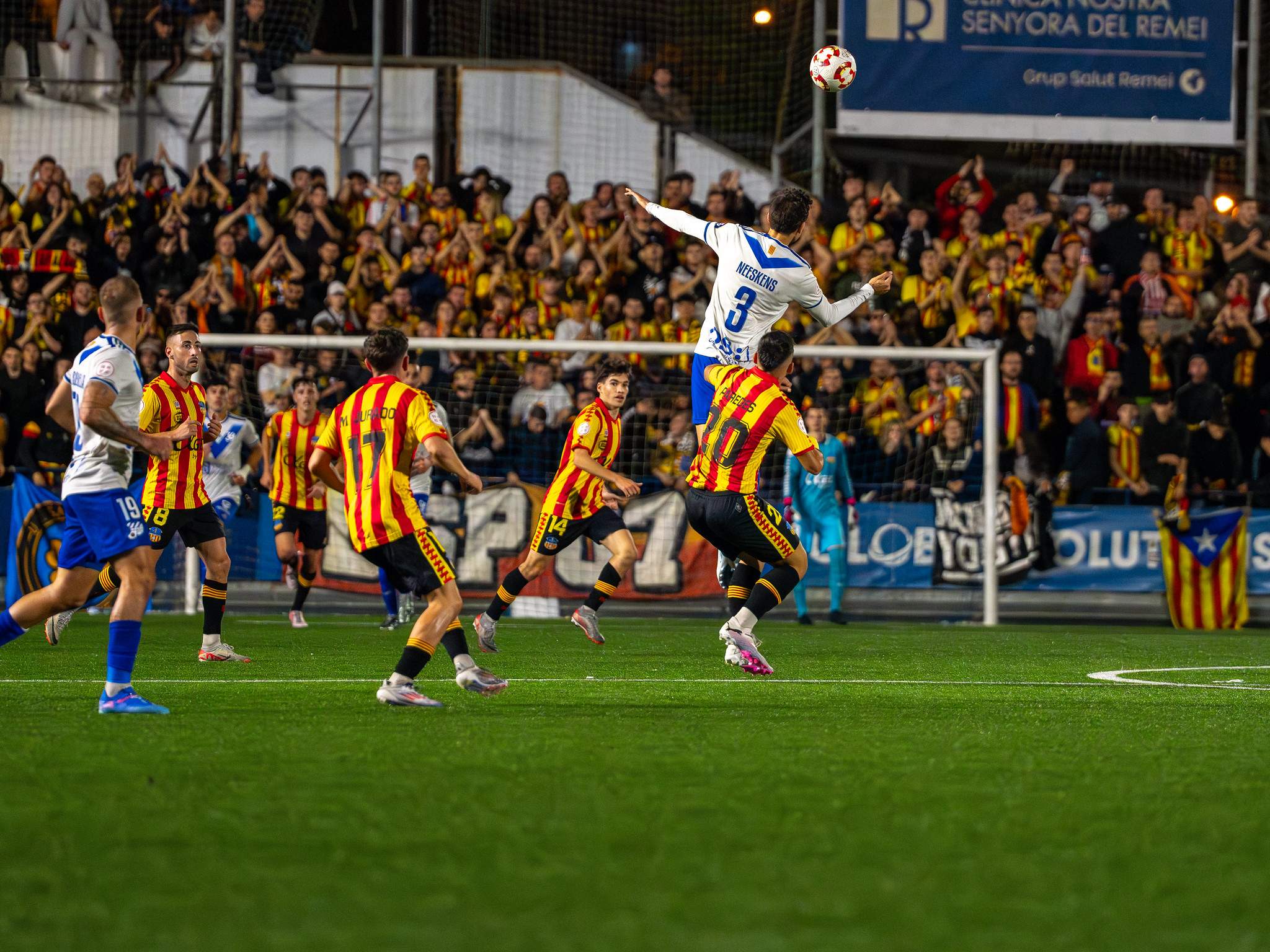 |
| A CE Europa player attempts to head the ball [Photo: UE Sant Andreu] |
UE Sant Andreu
Known for the amazing atmosphere at its home games at Camp Municipal Narcis Sala, UE Sant Andreu was founded in 1909 to give sports fans in Sant Andreu de Palomar a sports club, the first founded in the neighbourhood.
 |
| Sant Andreu's team stands in front of the club's fans [UE Sant Andreu] |
Initially known as Club Z and Andreuenc Foot-ball Club, the actual Sant Andreu was created in 1925 through a merger with another local club. It was forced to change name again in 1939 due the regime's will to "castillanize" sports clubs names, becoming Club Deportivo San Andrés, and it had to switch momentarily the red and yellow stripes for blue and yellow ones.
Until 2005, the club's crest still displayed the Spanish flag, a detail that appeared in 1939 with the forced rebranding of the club. A vote was held between the members to decide whether the club would change to a newly proposed badge or stick with the Francoist one, and the new proposal won by 177 to 139 votes.
 |
| History of UE Sant Andreu's badge [lafutbolteca.com] |
Having spent all of its history in the lower leagues, the club's two golden eras came in the early 50's and in the 70's, when los Quadribarrats spent nine consecutive seasons in the Segunda Division. Since then they've never been back, and will now compete in the third straight Segunda RFEF (the fourth tier) campaign after their promotion in 2023.
The club's identity is built on the strong relationship with the working-class of their barrio. Their spokesperson Gerard Alvarez claimed that the club's values are "anti-fascist, anti-racist, feminist, Catalanist, working class and human rights-defending".
Through these values Sant Andreu found a massive increase in support in the neighbourhood. The memberships skyrocketed from around 700 to almost 5000 in the span of five years, and could rise even more if the club stays true to its values and keeps its strong ties to the barrio Sant Andreu de Palomar.
 |
| Sant Andreu fans gather in the Placa Orfila [UE Sant Andreu] |
CE Europa
Club Esportiu Europa was founded in 1907 in the barrio Vila de Gràcia, a neighbourhood which was once the core of the old town of Gràcia famous for its Festa Major during which the Virgin of Gràcia is carried throughout the streets of the town.

Europa players attend the Festa Major [CE Europa]
Since the neighbourhood was annexed by the city of Barcelona, CE Europa has become, together with Sant Andreu, the biggest barrio club in the city and of the most important in the country.
Copa del Rey finalist in 1923, losing to the legendary Athletic Club that would go on to dominate Spanish football in a few years, Europa was one of the founders of the Primera Division. They have taken part in the first three seasons of the Spanish top flight between 1928 and 1931!
After the early success, Europa didn't compete between 1932 and 1940 and thus had to start over in the regional leagues. Since then it has spent most of its time in the Tercera Division (which was once the third and then the fourth tier) apart from a five year spell in the Segunda in the 60's.
Since its founding Europa has always played in a white and blue kit. Originally striped, since 1926 the kit displays a blue "V" shape over a white shirt. It is unclear how the iconic design was decided: according to some historians the choice was influenced by Birmingham City, who played a friendly in Barcelona in the 20's.
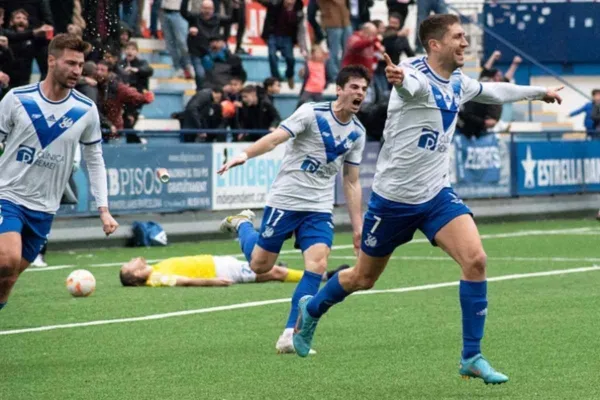
Europa's famous white and blue V shaped kits [CE Europa]
Europa plays its home matches at Nou Sardenya, a stadium which takes its name from the Cerdeña street close by. Built in 1940 after the civil war, the ground was demolished and completely rebuilt in 1995 with a 4000 capacity, enough to host the 2500 club members on regular matchdays but a bit smaller than their rivals' 6600 seater Narcis Sala. Both arenas regularly sell out on derby days though, with tickets unavailable weeks before the match!

The Nou Sardenya in the middle of Gràcia [espanaestadios.com]
Derbi del Pla de Barcelona
The rivalry between these two sides is called Derbi del Pla de Barcelona ("Derby of the plain of Barcelona") and it has been getting more and more intense since the late 2000's, when the two clubs started facing each other more often.
Europa and Sant Andreu found themselves fighting against each other from the fifth tier in the 2022-23 season, having a memorable battle which culminated in a tense derby on matchday 27 of 30.
Sant Andreu, two points behind in the standings, led 1-0 for most of the match, but two late red cards left them with nine men to defend the league and the possible jump in the standings. Europa silenced the home crowd in the 96th minute through Ricard Vidal, claimed the top spot back and went on to win promotion on the last match of the season despite losing more points between the derby and the last day.
Sant Andreu missed out on first place but found joy in the playoffs, defeating Salamanca and Peralada and earning promotion themselves to keep the derby going in the next season.
Both clubs did well in the fourth tier in 2023-24. Europa was just two points off another promotion, but both clubs ended up qualifying for the playoffs. The Europeistas were defeated by Real Betis' second team, and Sant Andreu was eliminated by Zamora CF.
Europa won both derbies, 3-0 and 2-3, keeping the crown of best neighbourhood club in Barcelona. But not for long.

CE Europa fans display a Greek-themed tifo in the derby [CE Europa]
On December 11th, 2024, a historic derby took place at Europa's Nou Sardenya. Sant Andreu, who had not won in the barrio of Gràcia in a very long time, striked first in the third minute. Europa responded instantly, but then Sant Andreu scored again, then Europa equalized again, the Sant Andreu went ahead again, then Europa equalized again... Then Sant Andreu scored again. 3-4. A high scoring match, yeah, but this was just the first half!
Sant Andreu ended up winning the craziest Pla de Barcelona derby 4-6, but those three points were only good enough to qualify for the playoffs, where they would go on and lose to Rayo Majadahonda. Europa, on the other hand, won the league and was promoted and will spend the next season in the third tier.
A dense decade of derbies has made this rivalry grow exponentially. Although the fixture won't happen in the league next year, chances are the two sides meet again soon and gift us another great battle of the barrios.
Comments
Post a Comment