Everyone loves an underdog. Whether it's an unlikely Champions League run, a small nation making the World Cup or your notoriously untalented friend scoring a worldie in your Sunday League match, enjoying a spectacular event happening against the odds makes countless predictable matches worth the wait.
Sweden's Allsvenskan has taken this concept a step further. Despite crowning an astonishing 11 different clubs as champions between 2000 and 2024, this year has surpassed any possible result in terms of shock.
The 2025 edition of Sweden's top tier has been won - mind you, dominated - by Mjällby AIF, a club based in Hällevik, a town located in Blekinge County, which by land mass is the smallest in the country.
 |
| Tom Pettersson celebrates the title [Getty Images] |
Blekinge län, as the Swedes would call it, is home to about 150,000 people, and happens to be less than any of the 10 biggest metropolitan areas in the country. Of these 150,000, just 17,000 live in the municipality of Sölvesborg, and only 1,485 live in Hällevik itself. Yes, the place is small.
 |
| The village of Hällevik [maif.se] |
So, how come a club based in such a small town has become champion in a country of 10 million people? Are they a dictator's toy club, like Arkadag from Turkmenistan? Or did someone just splash some money in the project, like Ludogorets?
The answer is... neither. Despite being from such a small town, Mjällby play in Strandvallen, a stadium that can host up to 7,000 fans, and have averaged around 4,000 spectators pretty much in every season they've spent in the top flight. This year's been record breaking even in terms of crowds, as Mjällby attracted a never-seen-before average of 5,034 fans to their ground.
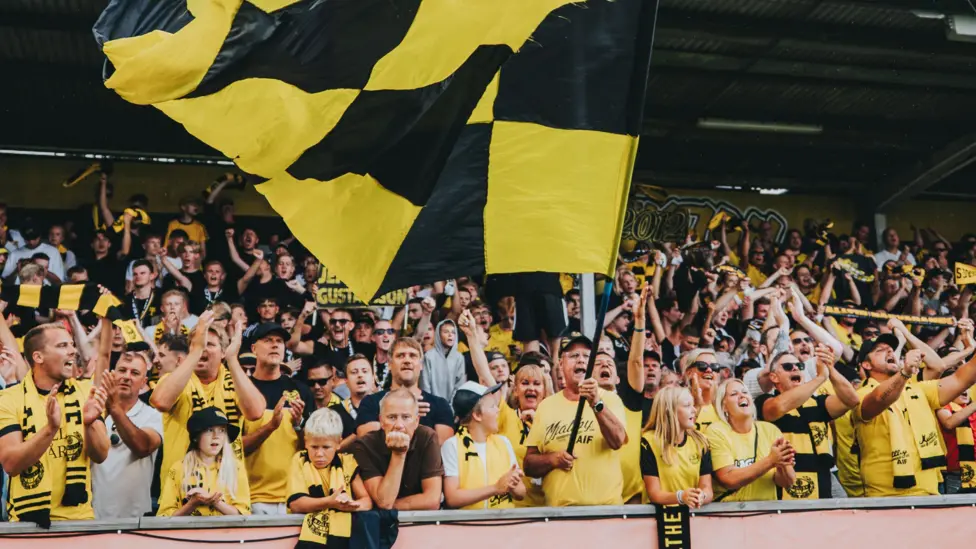 |
| Mjällby fans [Michael Smolski/Football Is Everywhere] |
This clearly means that the support for Mjällby spreads further than Hällevik's borders. Over the course of its 86 years of history, the black and yellows have spent 14 seasons in Allsvenskan. Since their first promotion in 1979, which was already seen as a massive result given the small community, the club has become the prominent force of the Blekinge county, whereas other clubs from the area, like Saxemara IF, Sölvesborgs GoIF and Hörvikens IF, remained in the lower divisions.
In the last few decades Mjällby has been yo-yoing between the first and second division, but developed a stability that allowed it to obtain better results in the 2000's. Since their promotion in 2009, they've achieved multiple mid-table finishes and have built a reputation for their youth development and scouting in the region.
The decisive switch happened in 2023. The club appointed manager Anders Torstensson for a third spell after his 2013 and 2021 stints, who guided the team to its first ever Swedish Cup final after defeating local rivals Kalmar FF on penalties and Stockholm giants Hammarby in the semis. Unfortunately, Mjällby lost the final 1-4 to Häcken, but this run was a sign of things to come.
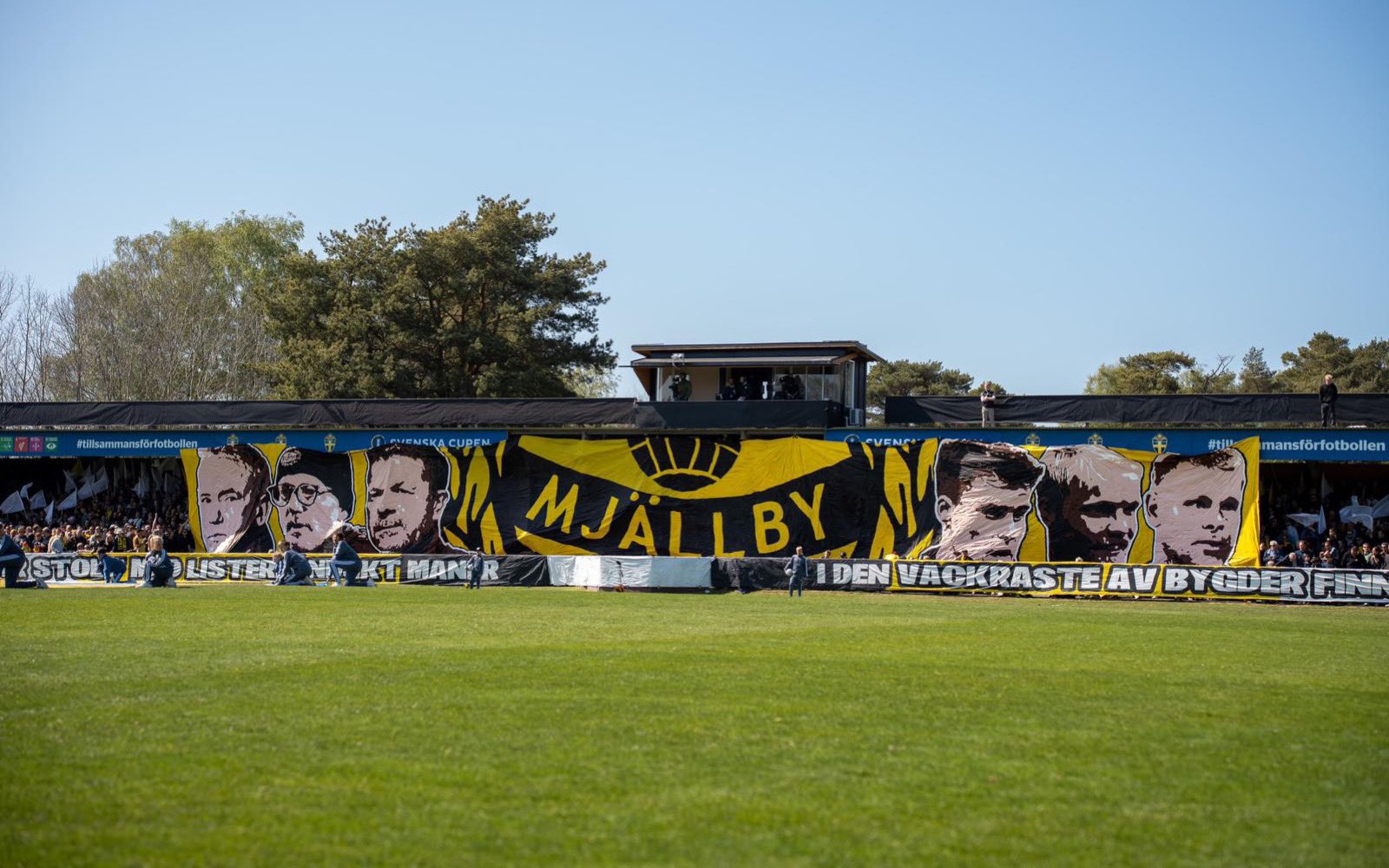 |
| Mjallby's tifo in the 2023 Svenska Cupen final [Mjallby AIF] |
Finishing mid-table in 2023 and creeping up on the European spots in 2024 (Mjällby finished just four points behind 2nd and 3rd placed Hammarby and AIK) further encouraged the sentiment that the black and yellows were getting close to the top, but nothing prepared the village of Hällevik for what was coming next.
At the time of writing, their record shows 27 league matches, of which 20 are victories, 6 are draws and the only loss came in the 8th matchweek away at AIK. That means they're currently 19 matches unbeaten in a row. Impressive, considering the clubs they've faced: Hammarby, Malmö, AIK, Djurgården, Elfsborg and Hacken.
Last but not least, they've defeated IFK Göteborg at Gamla Ullevi. Before Malmö's dominant years from 2010 onwards, Göteborg was the most successful club in Sweden, having won 18 Allsvenskan titles, 8 cups and more importantly two legendary UEFA Cups in the 1980s.
Mjällby's victory in Göteborg on October 20th is therefore destined to remain in Swedish football history. Thanks to Tom Pettersson and Jacob Bergström's goals, the small club from Hällevik have become the newest Swedish champions with three matches to spare, and they've done it on the ground of one of the country's most historic clubs.
They've done this, according to Capology.com, with Allsvenskan's third lowest payroll (just €2.2m, compared to Malmö's €9.9m), and, according to Transfermarkt, the 9th most valuable squad in the league (€16.9m, with Malmö once again top at €36.5m).
They've done this mainly using footballers they recruited from their own region, to the point that the majority of the starting eleven have only ever played top flight football for Mjällby over their careers.
They've done this despite never even coming close before and despite never being to Europe in their history. And they've done it so well they only need one more point from the last three matches to equal Malmö and AIK's record of 67 points in a season.
So, to answer the question, how come such a small club have become champions? The answer isn't about money or power, it is about pure football. Mjällby have once again proven that the sport is still capable of producing such wonderful stories, and at a time where money and power are so loud, being reminded that on a football field 11 men can still take on the biggest names is pure hope for the future.
Comments
Post a Comment