Over the last few decades the month of December has seen a rise in popularity in actions called "Teddy Bear Toss". With Christmas approaching, spectators from many sports club all over the world gather as many stuffed toys as possible and throw them on the pitch.
These toys, gifted by thousands and thousands of fans, are then donated to hospitals and charities to be given to less fortunate children from the community, brightening their Christmas. When possible, the players themselves make the trip to personally give the toys to the children, making the whole thing extra special!
| Real Betis fans hold the teddy bear toss annually [businessinsider.com] |
The idea originated in Canada in 1993: Don Larson, then marketing director to ice hockey team Kamloops Blazers, promoted the idea for their home match on December 5th. The fans waited for the home team to score their first goal before tossing over 2,400 toys onto the ice!
 |
| Hockey club Kamloops Blazers were the first to hold the event [cfjctoday.com] |
The event was so successful that such initiatives quickly spread through Canada, mainly among other hockey teams, and then all over the world. Unfortunately, the American hockey league - the NHL - discourages people from throwing objects onto the ring, but the rest of the world made up for their absence by gifting more and more toys every year.
By 2014, this new way of doing charity had spread all the way to Australia, the other side of the planet, as hockey team Melbourne Ice collected over 300 toys to celebrate Canada Day in June. In the meantime, hockey clubs from Sweden and the United Kingdom, as well as Italian basketball teams, picked up on the new Christmas tradition, collecting thousands of gifts for the children.
After reaching Europe, it was inevitable that such a wholesome idea would then spread over to football. In most European cities football is the core of the local community, and presents the most potential for charity work such as the teddy bear toss.
In Belgium, Charleroi's ultras cause a delay in kick off time every December when they enjoy their nounours party ("teddy bear party") and absolutely flood their side of the pitch with toys of all sorts.
When Turkey and Syria suffered a terrible earthquake in February 2023, Istanbul-based club Beşiktaş set up a toss to gather as many toys as possible to donate to the children affected. Although a wound as deep as the one caused by the earthquake can't be cured in any way, the toys gifted to the children may have helped them a bit at a time where a lot of people have lost everything they had.
 |
| Besiktas held a teddy bear toss for the children who suffered the 2023 Turkish-Syrian earthquake [aljazeera.com] |
By the end of the year, the teddy bear toss had become extremely popular all over Europe. Real Betis was one of the first clubs to embrace this event, and held another toss in December 2023 in their La Liga fixture against Real Madrid, donating thousands of stuffed toys.
However, once the challenge reached Poland, world record numbers of toys became the norm: on October 1st, 2023, Jagiellonia Białystok reportedly gathered 110,000 mascots! Given that their stadium only holds around 22,000 spectators, the turn out was extremely positive, truly a great effort by the Jaga fans.
Nothing is more Polish than trying to beat another Polish club, so in September 2024 Widzew Łódź held a teddy bear throwing competition, with fans encouraged to throw as many teddy bears as possible onto the pitch. This time, almost 120,000 toys were collected! Ekstraklasa clubs truly have become pioneers of this specialty in the last few years.
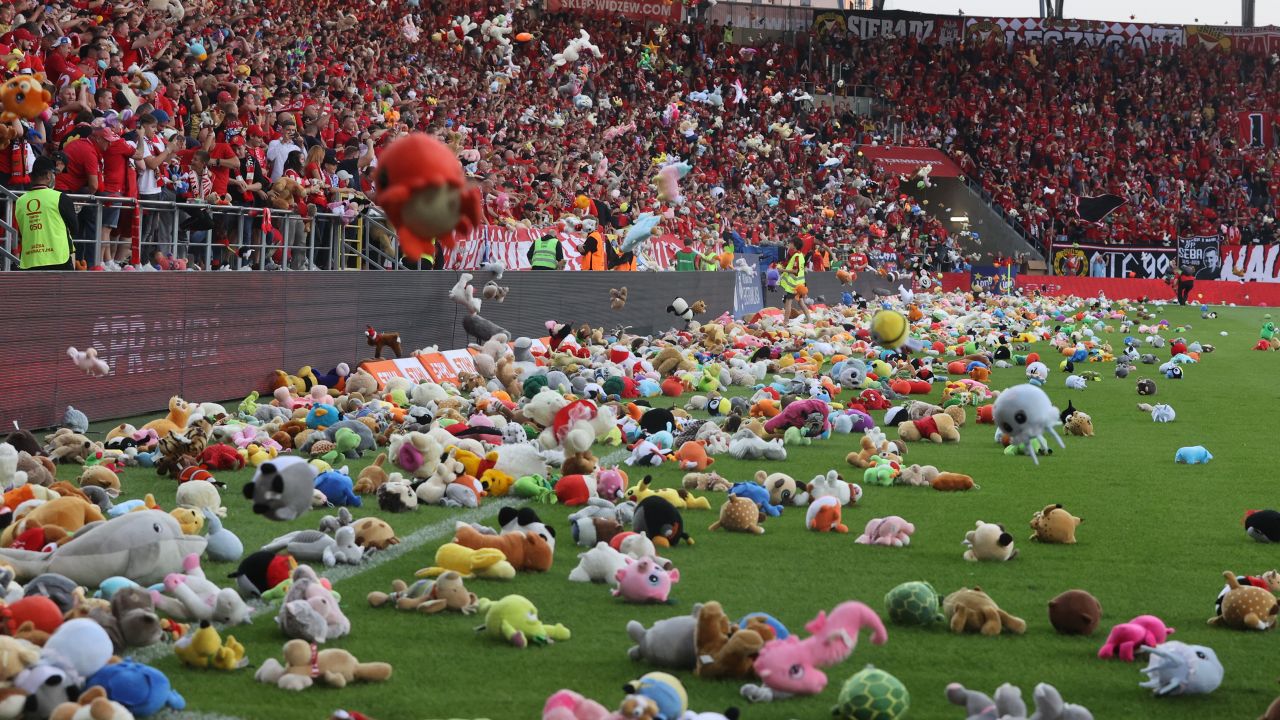
The aftermath of Widzew Łódź's record breaking teddy bear toss attempt [tvpworld.com]
Other clubs to have joined in on the charity were AFC Rushden & Diamonds from England, Excelsior from the Netherlands, Newcastle Jets from Australia, Catanzaro from Italy, CFC Atletico and Lexington SC from the U.S., but the traditions is still mainly a hockey thing and we really have to thank Canadian hockey clubs for creating it!
Comments
Post a Comment