Greenwashing is a marketing strategy which aims at wrongly persuading the public that a company's products or operations are environmentally friendly. It is a form of gaslighting which makes customers believe that by purchasing said company's services they won't harm the planet in any way, but reality is often very different from what the customer may think.
One example of this practice was gifted to us by the world's leading plastic polluter, Coca-Cola, which for years has been claiming that it is lessening its plastic waste, with the goal of "getting every bottle back by 2030". As admirable as such claims may be, they are also way too optimistic to be true: they were sued in 2021 for false claims, and in 2024 they were still first in the pollution race by quite some margin, more than doubling the waste produced by second placed PepsiCo.
The phenomenon of greenwashing has spread over many industries, including sports. FIFA, which is not a great example of consistency and transparency, committed to "environmental action" in 2021 only to then announce a partnership deal with Saudi oil giants Aramco in 2024. Formula 1, which relies on massive amounts of air and naval transport every season, often claims that they're aiming at net zero carbon emissions, while also adding more and more events in countries whose only relevant export is oil.
Forest Green Rovers
In such a fake world made of slogans forged to steer the public opinion at will, it is hard to recognise institutions that really do what the claim. Forest Green Rovers are the most notable example of football club that has embraced an environmentally friendly approach: in 2018 they became the first club in the world to be certified carbon neutral by the United Nations.
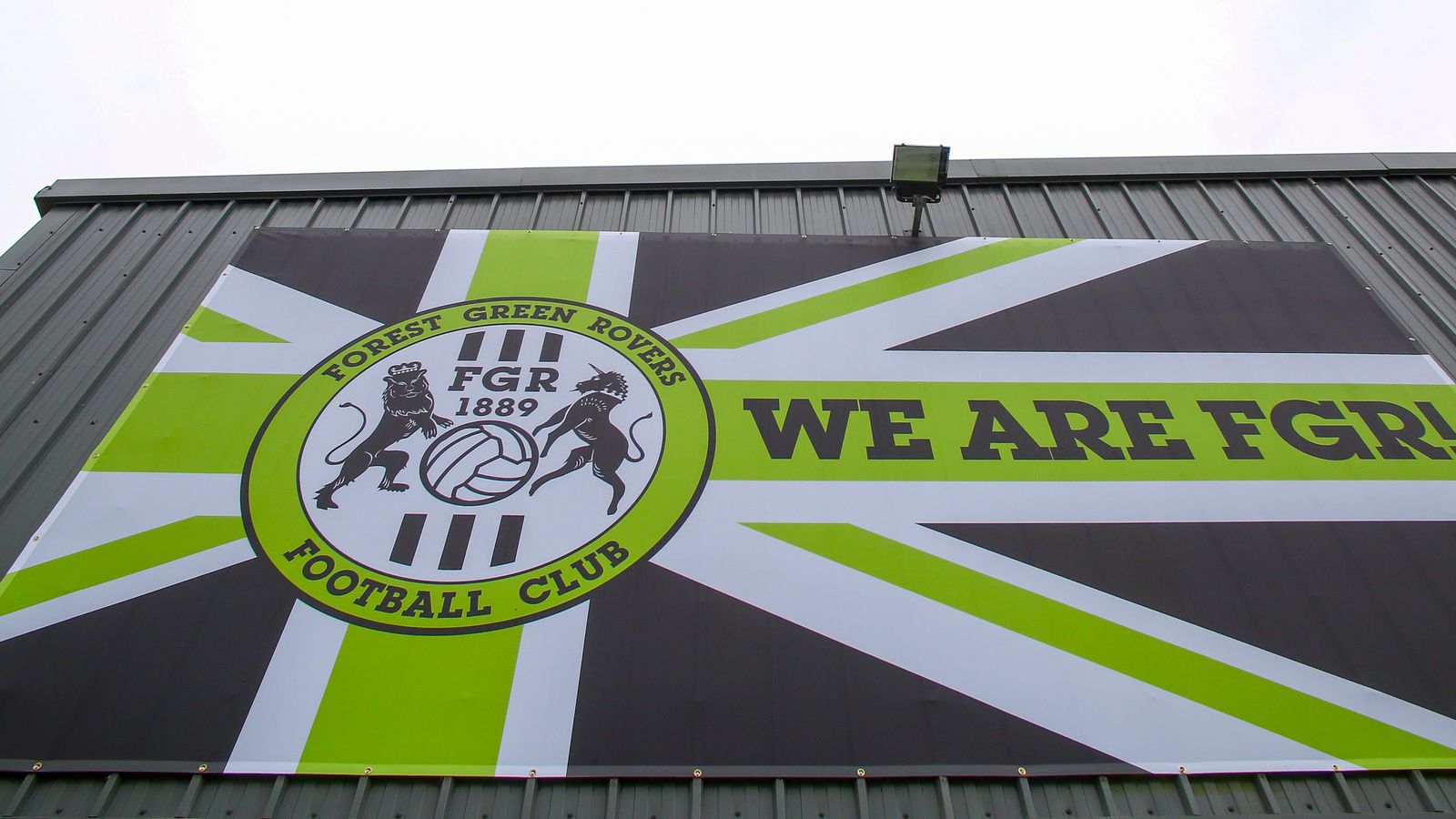 |
| Forest Green Rovers have become the first carbon neutral club in the world [ph: Sky Sport] |
Forest Green were founded in 1889, and competed in local leagues for most of its history, and it wasn't until green energy industrialist Dale Vince became a shareholder that the club would really turn green.
Vince is the founder and owner of Ecotricity, a company specialised in selling green energy which mainly comes from wind power. Ever since becoming chairman at the club in 2010, he's pushed for a more sustainable approach: he almost instantly banned the players from eating red meat, later extending the ban to all products sold at the ground.
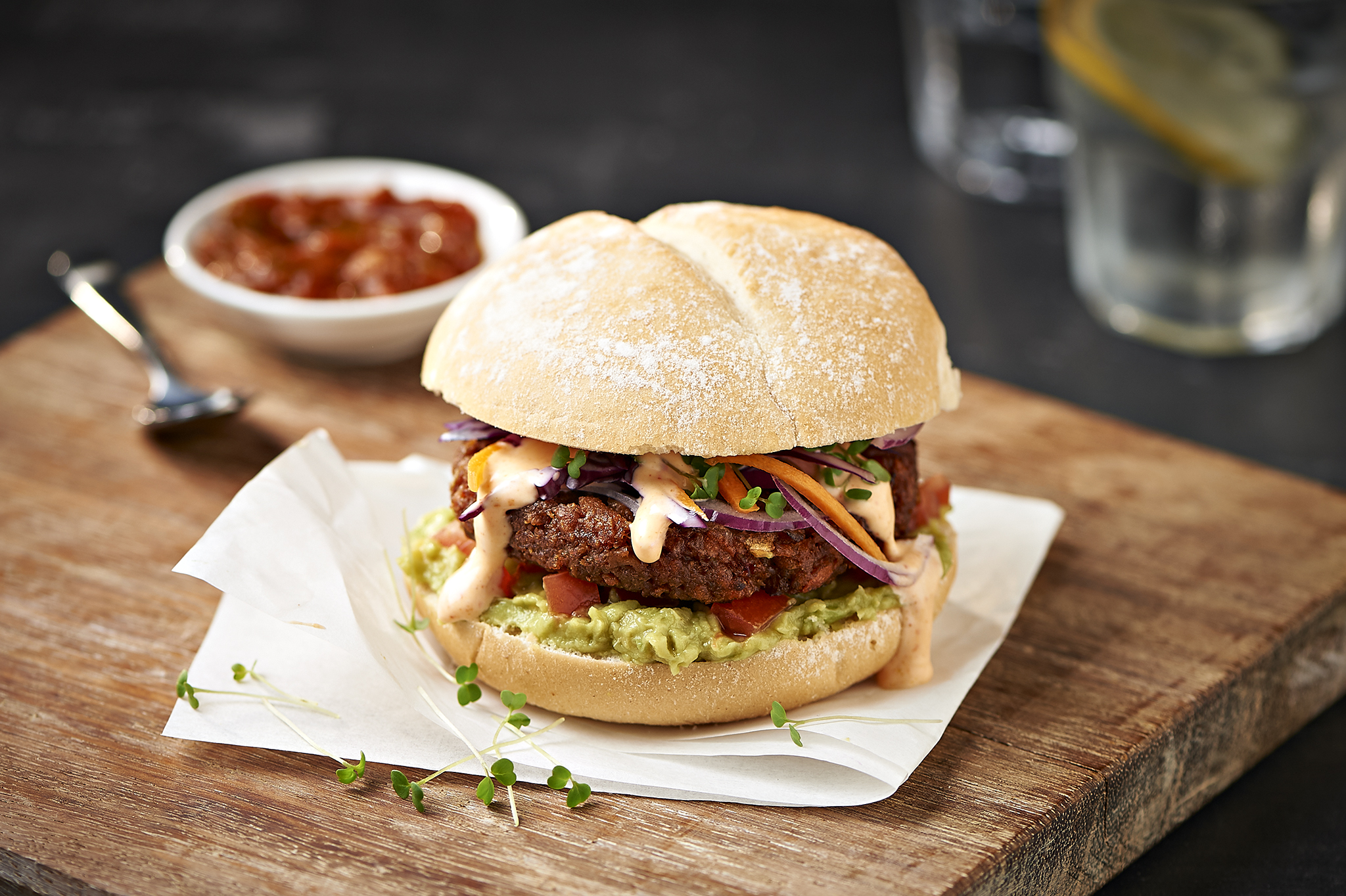 |
| Forest Green's own vegan hamburger [ph: Forest Green Rovers] |
Further improvements saw the club adopt solar-powered robot grass mower, an organic football pitch and solar panels over the stands at New Lawn, and by October 2015 Forest Green had become the world's first vegan football club.
However, some of the changes made by Vince proved to be controversial. In 2012, the club announced the intention to switch from their classic black and white striped shirts to a lime green shirt with black shorts, leaving many supporters in dismay. By 2014 it was decided to bring the black stripes back, but still keeping the lime green instead of the white.
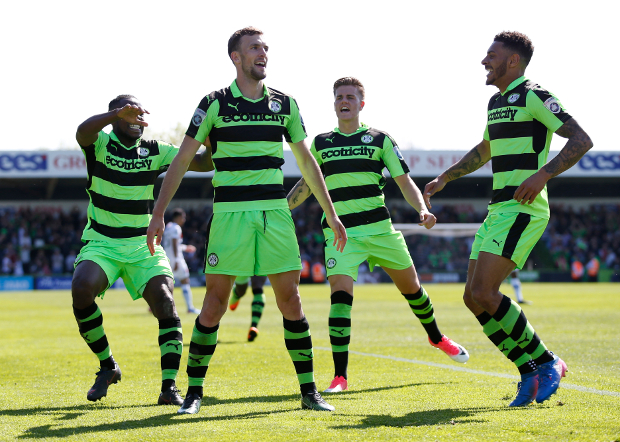 |
| Forest Green's players celebrate in their lime green and black kits [thenonleaguefootballpaper.com] |
The changes off the field coincided with more success on it: after 19 consecutive seasons in the National League, Forest Green defeated Tranmere Rovers at Wembley to earn promotion to League Two, making Nailsworth the smallest town to ever host a Football League club at just 7,700 inhabitants. After narrowly avoiding relegation in 2018, the club finished in the playoffs a couple times before winning the title in 2022 and earning promotion to League One. Two straight relegations then followed, and the club is now back in the National League.
In 2016, the club announced a new stadium to be built within the Eco Park in Gloucestershire, made entirely of wood, with a capacity of 5,000 which could be increased to 10,000. The Football League approved the new ground in 2021, but so far no progress has been made in its development and Forest Green still play at New Lawn.
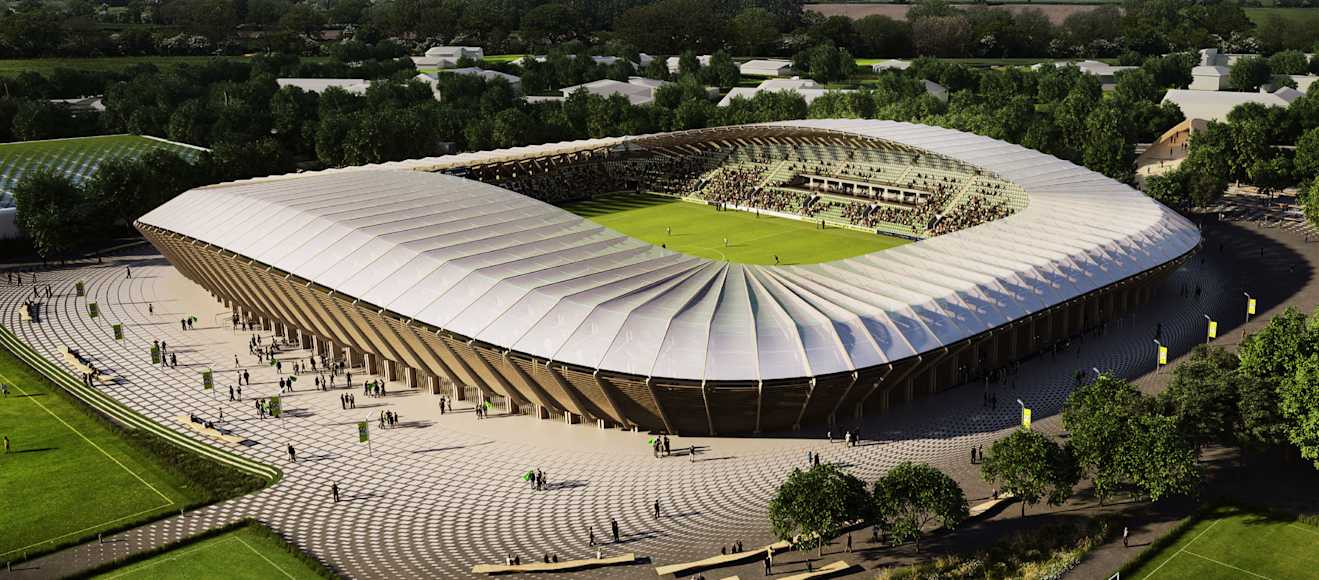 |
| The proposed new stadium in Eco Park [ph: Forest Green Rovers] |
According to Dale Vince, Gloucestershire Highways are delaying the construction, as the area needs a dual carriageway to relieve traffic from and to the new stadium and the proposed business park, so the application has yet to be approved.
Nevertheless, despite the struggle to unlock the stadium situation and the club falling off of the Football League, Forest Green have made their name known to the football world and have been an example of virtue, trying to steer the game to a more environmentally sustainable approach.
Vermont Green
In the United States, the success achieved by Forest Green Rovers inspired the creation of a similar club: Vermont Green, based in Burlington, Vermont, were founded in 2021 and have a clear mission centered on environmental justice. Les Verts, just like their British counterparts, aim at becoming a net zero football club themselves.
 |
| Vermont Green's fans at Virtue Field in Burlington [ph: New York Times] |
Ever since its beginning the club has been defined by a strong culture: Vermont Green's efforts to social engagement and environmental sustainability have become its identity, becoming an institution beyond the football field and a net positive addition to the communities of Burlington.
The club itself has imposed five main goals which it seeks to achieve:
- Net-zero emissions
- Fight systemic racism
- Donation of 1% of the annual sales to environmental associations
- Use of recycled materials in the club's merchandise
- Promotion of education and awareness on influencing change
These goals are so important to the club that according to founder Keil Corey "Vermont Green is a soccer club that's not about soccer". The choice of Burlington as the home of the club was not by chance: in 2014, the Vermont city became the first in the U.S. to draw 100% of its energy from renewable sources. The community really believes it can make a change, and have supported the new club from the start.
In the first ever match in 2022, over 1,000 spectators cheered on the Vermont Green, a huge number for a USL League Two side, which reached capacity 2,500 by the end of the first season. In fact, in 2023 the 1,250 season tickets available were sold out quickly.
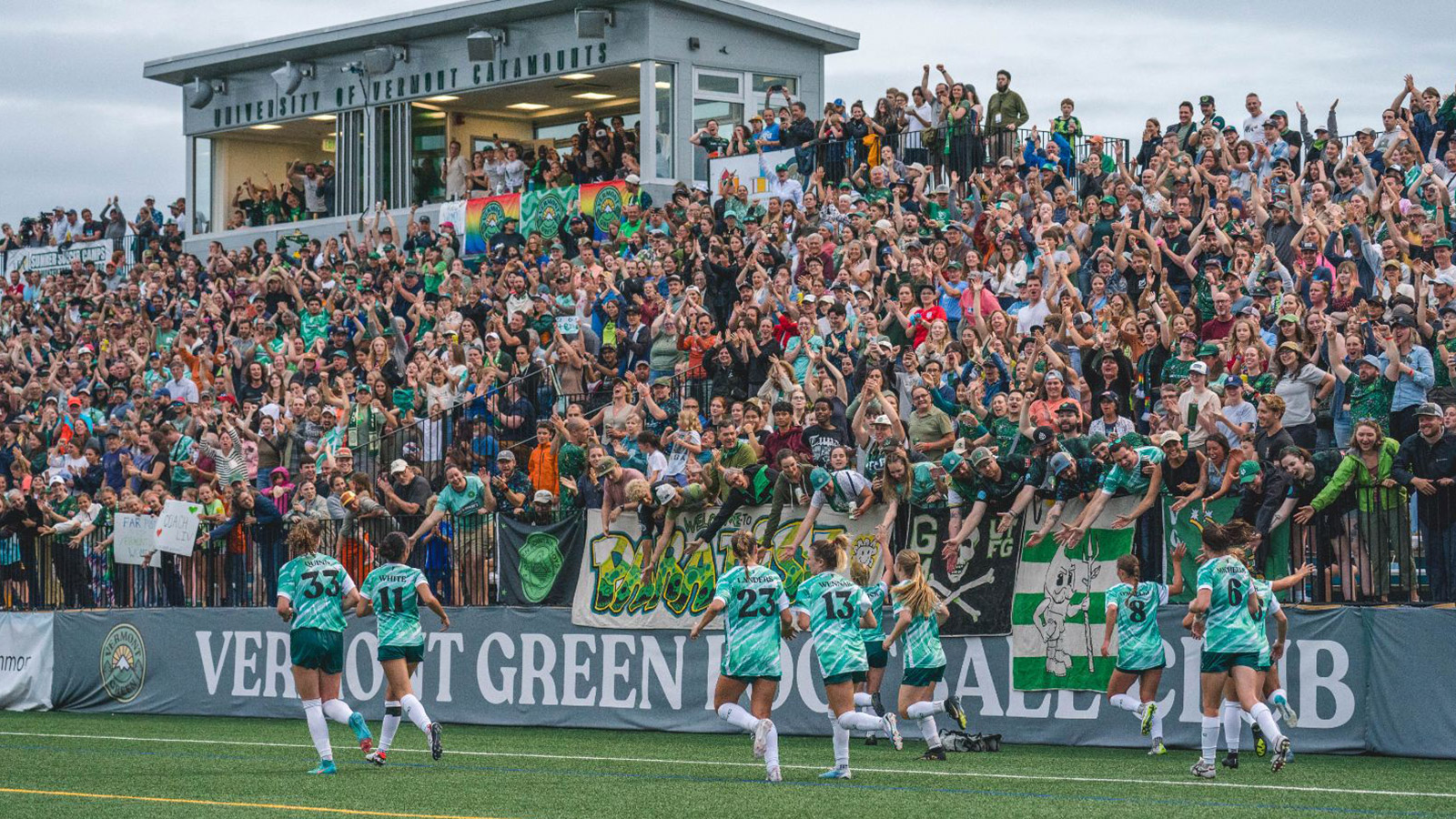 |
| A sold out crowd cheers on the women's team of Vermont Green [ph: Vermont Green] |
Ever since, the club has been growing in terms of community. The results, however, have always been excellent. Between 2022 and 2024 the team always finished in third place in its division, but it was 2025 that put Vermont Green on the map: unbeaten in the league phase, they finally won their division title. In the playoffs, they defeated the Hudson Valley Hammers, then FC Motown and then Lionsbridge FC to conquer the Eastern Conference title.
They qualified for the National semifinals, where they defeated the Dothan United Dragons on penalties, and then beat Ballard FC in the championship match 2-1 with Kissel's winning goal in stoppage time in front of 5,000 spectators at their own Virtue Field.
 |
| Vermont Green celebrate their title win [vtdigger.com] |
The 2025 has thus been record breaking for Vermont Green: undefeated National champions for the first time in their history!
In 2026 they will again compete in the USL League Two, as promotions and relegations have not yet been introduced in the USA. Despite this, their growth has been admirable, and it's exciting to know that their project is still fresh and has a very high ceiling, thanks to the mission of the founders and the will of Burlington and all of Vermont to support such a special football club.
If you're interested in another unique non-league English club, I've also covered St. Albans' story.
If instead you want to know more about another USL League Two club, San Francisco City FC's community approach will be a good read!
Comments
Post a Comment